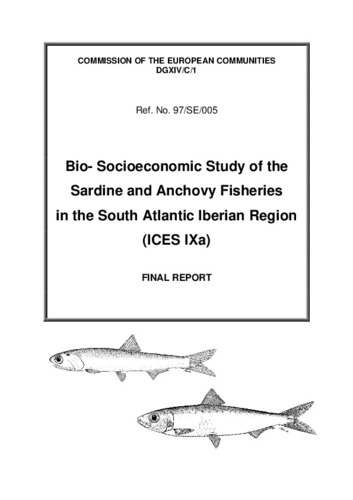
Bio- Socioeconomic Study of the Sardine and Anchovy Fisheries in the South Atlantic Iberian Region (ICES IXa)
Identificadores
Statistics
Export





Metadata
Show full item recordAlternative title
Estudio biosocioeconómico de las pesquerías de sardina y boquerón en la región suratlántica ibérica (ICES IXa)

Date
2012-09-06Source
COMMISSION OF THE EUROPEAN COMMUNITIES DGXIV/C/1-2000; pp.220Abstract
A study has been carried out of the fisheries of sardine (Sardina pilchardus) and
anchovy (Engraulis encrasicholus) of the Iberian South Atlantic region, specifically the Gulf of Cádiz and the Algarve. The perspectives of the study are both biological and socioeconomic, with the starting point being actual catches landed at the various ports of these regions.
The characteristics of both the Spanish and Portuguese purse seine net fishing
fleets have been studied, analysing the operations, activities and costings of the boats,owners and crews, considering also the cofradías (fishermens’ associations), the owners’associations producers’ organisations or cooperatives. Two basic types of fleet have been differentiated in the Spanish zone : that of Cádiz (36 boats) and Huelva (31 boats), on the basis of the characteristics of the boats (gross tonnage, engine HP, crew numbers, etc.); the more important of the markets served by these are Cádiz, El Puerto, Punta Umbría and Huelva. In the case of Portugal, the total fleet studied comprises the 67 vessels, only 30, associated in one or other of the Producers’ Organisations (OPs): Barlapesca and Coopalgarvia; the two most relevant landing ports for these boats are Olhao and Portimao.
From the results of our study and the conclusions drawn from the study of catches
landed during the period 1985-1998, the ports of Cádiz, Olhao and Portimao were selected to conduct the biological study of the two species, on the basis of specimens caught by the same fleet. A total of 3,533 specimens of sardine (2000, 731 and 822, respectively, from Cádiz, Olhao and Portimao) and 4,187 of anchovy (3.976 from Cádiz and 211 from Olhao)have been analysed. In each species, our study has included the monthly variation in total length (TL), weight (W), age (by the otolith method), sex ratios, fatness condition (K), the gonadosomatic index (GSI), vicerosomatic index (VSI), repletion index (RI), L¥, k, w, and
j´. The results obtained have been compared with those reported in previous studies of these same species.
The most appropriate models of production (by Schaeffer and Fox) have been
applied to the data collected on the two species, particularly the catch and fishing effort required to achieve this, in order to determine Maximum Sustainable Yield (MSY) and the Total Admissible Catch for each. The economic parameters estimated include: total cost per unit of effort ( the variable cost or c), total fixed cost (FC), total cost (% v), VAT (u %)and the demand function, for both the Gulf of Cádiz and the Algarve for the purpose of developing the theoretical model, which we have then applied to determine the optimum state of exploitation of the two fisheries (Objectives I and II as proposed by Clark),studying the growth, fishing effort and the markets to produce a simulation of the profit and loss accounts for the two Spanish fleets.
Lastly, a series of possible improvements for the regulation of fishing activity have been proposed, taking into account the number of days per year, the average profit for the boat owners and the average remuneration for the boat crew members. A suggested figure of 210 days/year per boat was taken as the basis for our “optimum state” calculations. In the case of the Cádiz fleet, the simulated results could be described as good, although the fact cannot be avoided that the economic future of this particular purse seine fleet is increasingly uncertain as it depends crucially on the outcome of the negotiations between the European Union and Morocco. In respect of the Huelva fleet, in relative terms, the results of the optimum state simulation would represent an increase of over 170% in the average annual profit of the owners and an increase of nearly 30% in the average remuneration of the crew members ; however, these % increases are from extremely low bases, in absolute terms. For example, comparison of the simulations for actual (non optimum) conditions for 1998 indicate an average crew remuneration in Huelva that is barely half of that in Cadiz, for considerably more days fishing. In reality, our proposals should only be seen as a worthwhile first step towards adequate returns on capital and labour for the Huelva fleet.
Collections
- Libros [583]
- Monografías Biología [7]

This work is under a Creative Commons License Attribution-NonCommercial-NoDerivs 3.0 Unported