• español
    • English
  • Login
  • español 
    • español
    • English

UniversidaddeCádiz

Área de Biblioteca, Archivo y Publicaciones
Comunidades y colecciones
Ver ítem 
  •   RODIN Principal
  • Institutos de Investigación
  • Instituto de Investigación en Biomoléculas INBIO
  • Artículos Científicos INBIO
  • Ver ítem
  •   RODIN Principal
  • Institutos de Investigación
  • Instituto de Investigación en Biomoléculas INBIO
  • Artículos Científicos INBIO
  • Ver ítem
JavaScript is disabled for your browser. Some features of this site may not work without it.

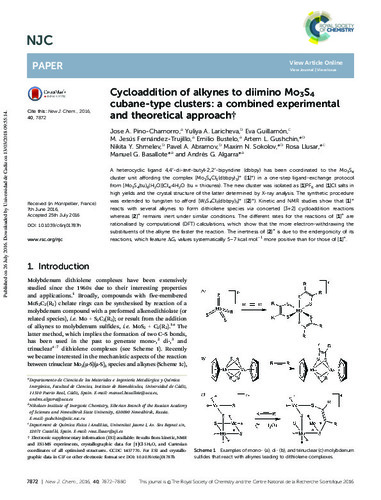
Cycloaddition of alkynes to diimino Mo3S4 cubane-type clusters: a combined experimental and theoretical approach
Thumbnail
Identificadores

URI: http://hdl.handle.net/10498/20490

DOI: 10.1039/c6nj01787h

Ficheros
Acceso cerrado (1.961Mb)
Estadísticas
Ver estadísticas
Métricas y Citas
 
Compartir
Exportar a
Exportar a MendeleyRefworksEndNoteBibTexRIS
Metadatos
Mostrar el registro completo del ítem
Autor/es
García Algarra, AndrésAutoridad UCA; Pino-Chamorro, Jose Ángel; A. Laricheva, Yuliya; Guillamón, Eva; Fernández-Trujillo Rey, María JesúsAutoridad UCA; Bustelo, Emilio; L. Gushchin, Artem; Y. Shmelev, Nikita; A. Abramov, Pavel; N. Sokolov, Maxim; Llusar, Rosa; García Basallote, ManuelAutoridad UCA
Fecha
2016
Departamento/s
Ciencia de los Materiales e Ingeniería Metalúrgica y Química Inorgánica
Fuente
New Journal of Chemistry 2016, 40, 7872--7880
Resumen
A heterocyclic ligand 4,40-di-tert-butyl-2,20-bipyridine (dbbpy) has been coordinated to the Mo3S4 cluster unit affording the complex [Mo3S4Cl3(dbbpy)3]+ ([1]+) in a one-step ligand-exchange protocol from [Mo3S4(tu)8(H2O)]Cl4 4H2O (tu = thiourea). The new cluster was isolated as [1]PF6 and [1]Cl salts in high yields and the crystal structure of the latter determined by X-ray analysis. The synthetic procedure was extended to tungsten to afford [W3S4Cl3(dbbpy)3]+ ([2]+). Kinetic and NMR studies show that [1]+ reacts with several alkynes to form dithiolene species via concerted [3+2] cycloaddition reactions whereas [2]+ remains inert under similar conditions. The different rates for the reactions of [1]+ are rationalised by computational (DFT) calculations, which show that the more electron-withdrawing the substituents of the alkyne the faster the reaction. The inertness of [2]+ is due to the endergonicity of its reactions, which feature DGr values systematically 5–7 kcal mol 1 more positive than for those of [1]+.
Colecciones
  • Artículos Científicos [11777]
  • Articulos Científicos CC. Mat. [566]
  • Artículos Científicos INBIO [417]
Attribution-NonCommercial-NoDerivatives 4.0 Internacional
Esta obra está bajo una Licencia Creative Commons Attribution-NonCommercial-NoDerivatives 4.0 Internacional

Listar

Todo RODINComunidades y ColeccionesPor fecha de publicaciónAutoresTítulosMateriasEsta colecciónPor fecha de publicaciónAutoresTítulosMaterias

Mi cuenta

AccederRegistro

Estadísticas

Ver Estadísticas de uso

Información adicional

Acerca de...Deposita en RODINPolíticasNormativasDerechos de autorEnlaces de interésEstadísticasNovedadesPreguntas frecuentes

RODIN está accesible a través de

OpenAIREOAIsterRecolectaHispanaEuropeanaBaseDARTOATDGoogle Académico

Enlaces de interés

Sherpa/RomeoDulcineaROAROpenDOARCreative CommonsORCID

RODIN está gestionado por el Área de Biblioteca, Archivo y Publicaciones de la Universidad de Cádiz

ContactoSugerenciasAtención al Usuario

