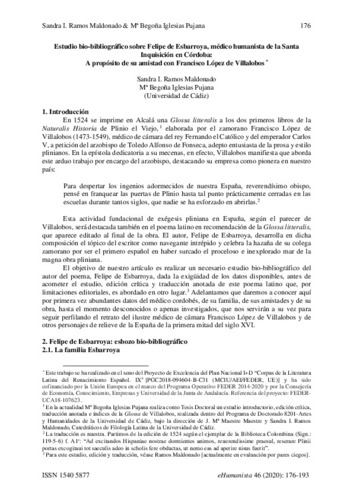
Estudio bio-bibliográfico sobre Felipe de Esbarroya, médico humanista de la Santa Inquisición en Córdoba: A propósito de su amistad con Francisco López de Villalobos
Identificadores
URI: http://hdl.handle.net/10498/24418
URL: www.ehumanista.ucsb.edu/sites/default/files/sitefiles/ehumanista/volume46/ehum46.ramos.pdf
ISSN: 1540-5877
Statistics
Export





Metadata
Show full item record
Date
2020Source
eHumanista. Journal of Iberian Studies 46 (2020), pp. 176-193.Abstract
This piece of work makes a first bio-bibliographic outline about Felipe de Esbarroya, Cordovan doctor of the Spanish Inquisition. His family, apothecaries of Genoese origin, had connections with the Cervantes family and Cristóbal Colón. His Latin writings include a colloquium and some poems in praise of works by professors from the University of Alcalá and friends related to the Spanish King Carlos I in front of the "Comuneros”, such as Rodrigo de Cueto, Lorenzo Balbo de Lillo and, especially, Francisco López de Villalobos, whose Plinian exegesis he praises as a pioneering work. Primer estudio bio-bibliográfico realizado sobre Felipe de Esbarroya, médico cordobés de la Santa Inquisición, cuya familia de boticarios, de origen genovés, tuvo conexiones con la familia Cervantes y con Cristóbal Colón. Entre sus obras destacan un coloquio y unos poemas latinos en elogio de obras de profesores de la Universidad de Alcalá y de amigos afines al rey español frente a los Comuneros, como Rodrigo de Cueto, Lorenzo Balbo de Lillo y, muy especialmente, Francisco López de Villalobos, cuya labor pionera en la exégesis pliniana alaba.
Collections
- Artículos Científicos [12089]

This work is under a Creative Commons License Attribution-NonCommercial-NoDerivatives 4.0 Internacional