El papel del lector y su auge en la reciente teoría literaria francesa
Identificadores
URI: http://hdl.handle.net/10498/25661
DOI: 10.18239/ocnos_2021.20.2.2388
ISSN: 1885-446X
ISSN: 2254-9099 (internet)
Files
Statistics
Metrics and citations
Export





Metadata
Show full item recordAlternative title
The role of the reader and its increasing importance in current French literary criticism
Author/s
Pardo Jiménez, Pedro Gregorio
Date
2021Source
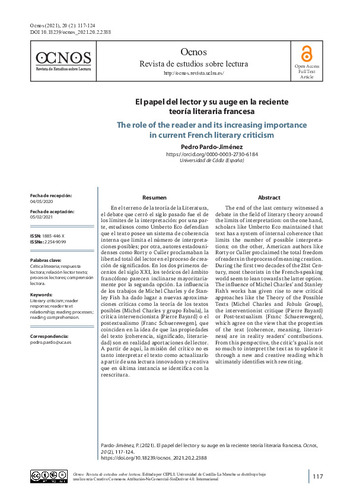
Ocnos (2021), 20 (2): 117-124Abstract
En el terreno de la teoría de la Literatura,
el debate que cerró el siglo pasado fue el de
los límites de la interpretación: por una parte,
estudiosos como Umberto Eco defendían
que el texto posee un sistema de coherencia
interna que limita el número de interpretaciones
posibles; por otra, autores estadounidenses
como Rorty o Culler proclamaban la
libertad total del lector en el proceso de creación
de significados. En los dos primeros decenios
del siglo XXI, los teóricos del ámbito
francófono parecen inclinarse mayoritariamente
por la segunda opción. La influencia
de los trabajos de Michel Charles y de Stanley
Fish ha dado lugar a nuevas aproximaciones
críticas como la teoría de los textos
posibles (Michel Charles y grupo Fabula), la
crítica intervencionista (Pierre Bayard) o el
postextualismo (Franc Schuerewegen), que
coinciden en la idea de que las propiedades
del texto (coherencia, significado, literariedad)
son en realidad aportaciones del lector.
A partir de aquí, la misión del crítico no es
tanto interpretar el texto como actualizarlo
a partir de una lectura innovadora y creativa
que en última instancia se identifica con la
reescritura. The end of the last century witnessed a debate in the field of literary theory around the limits of interpretation: on the one hand, scholars like Umberto Eco maintained that text has a system of internal coherence that limits the number of possible interpretations; on the other, American authors like Rorty or Culler proclaimed the total freedom of readers in the process of meaning creation. During the first two decades of the 21st Century, most theorists in the French-speaking world seem to lean towards the latter option. The influence of Michel Charles' and Stanley Fish's works has given rise to new critical approaches like the Theory of the Possible Texts (Michel Charles and Fabula Group), the interventionist critique (Pierre Bayard) or Post-textualism (Franc Schuerewegen), which agree on the view that the properties of the text (coherence, meaning, literariness) are in reality readers' contributions. From this perspective, the critic's goal is not so much to interpret the text as to update it through a new and creative reading which ultimately identifies with rewriting.
Collections
- Artículos Científicos [11595]
- Articulos Científicos Fil. Fra. Ing. [321]

This work is under a Creative Commons License Attribution-NonCommercial-NoDerivatives 4.0 Internacional