Efficacy of management of associated dysfunctions on rotator cuff and long head of the biceps: systematic review
Identificadores
URI: http://hdl.handle.net/10498/25724
DOI: 10.1186/s13018-021-02621-0
ISSN: 1749-799X
Files
Statistics
Metrics and citations
Export





Metadata
Show full item record
Date
2021-08Source
Orthop Surg Res 16, 501 (2021)Abstract
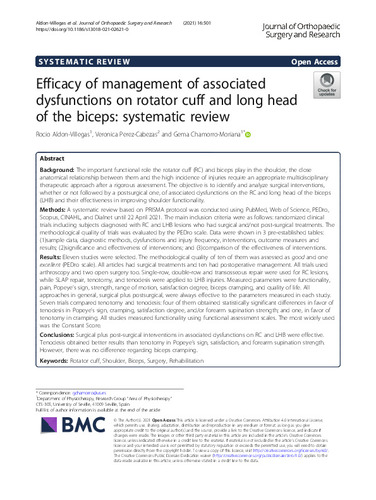
Background The important functional role the rotator cuff (RC) and biceps play in the shoulder, the close anatomical relationship between them and the high incidence of injuries require an appropriate multidisciplinary therapeutic approach after a rigorous assessment. The objective is to identify and analyze surgical interventions, whether or not followed by a postsurgical one, of associated dysfunctions on the RC and long head of the biceps (LHB) and their effectiveness in improving shoulder functionality. Methods A systematic review based on PRISMA protocol was conducted using PubMed, Web of Science, PEDro, Scopus, CINAHL, and Dialnet until 22 April 2021. The main inclusion criteria were as follows: randomized clinical trials including subjects diagnosed with RC and LHB lesions who had surgical and/not post-surgical treatments. The methodological quality of trials was evaluated by the PEDro scale. Data were shown in 3 pre-established tables: (1)sample data, diagnostic methods, dysfunctions and injury frequency, interventions, outcome measures and results; (2)significance and effectiveness of interventions; and (3)comparison of the effectiveness of interventions. Results Eleven studies were selected. The methodological quality of ten of them was assessed as good and one excellent (PEDro scale). All articles had surgical treatments and ten had postoperative management. All trials used arthroscopy and two open surgery too. Single-row, double-row and transosseous repair were used for RC lesions, while SLAP repair, tenotomy, and tenodesis were applied to LHB injuries. Measured parameters were functionality, pain, Popeye's sign, strength, range of motion, satisfaction degree, biceps cramping, and quality of life. All approaches in general, surgical plus postsurgical, were always effective to the parameters measured in each study. Seven trials compared tenotomy and tenodesis: four of them obtained statistically significant differences in favor of tenodesis in Popeye's sign, cramping, satisfaction degree, and/or forearm supination strength; and one, in favor of tenotomy in cramping. All studies measured functionality using functional assessment scales. The most widely used was the Constant Score. Conclusions Surgical plus post-surgical interventions in associated dysfunctions on RC and LHB were effective. Tenodesis obtained better results than tenotomy in Popeye's sign, satisfaction, and forearm supination strength. However, there was no difference regarding biceps cramping.
Collections
- Artículos Científicos [11777]
- Articulos Científicos Enf. Fisio. [320]
- Artículos Científicos INDESS [1015]

This work is under a Creative Commons License Atribución 4.0 Internacional