Methylene-Linked Bis-NHC Half-Sandwich Ruthenium Complexes: Binding of Small Molecules and Catalysis toward Ketone Transfer Hydrogenation
Identificadores
URI: http://hdl.handle.net/10498/25879
DOI: 10.1021/acs.organomet.1c00045
ISSN: 0276-7333
ISSN: 1520-6041 (internet)
Statistics
Metrics and citations
Export





Metadata
Show full item record
Date
2021-03Source
Organometallics 2021, 40, 792−803Abstract
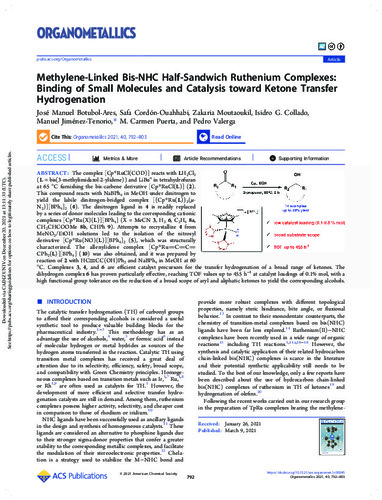
The complex [Cp*RuCl(COD)] reacts with LH2Cl2 (L = bis(3-methylimidazol-2-ylidene)) and LiBun in tetrahydrofuran at 65 degrees C furnishing the bis-carbene derivative [Cp*RuCl(L)] (2). This compound reacts with NaBPh4 in MeOH under dinitrogen to yield the labile dinitrogen-bridged complex [{Cp*Ru(L)}(2)(mu-N-2)][BPh4](2) (4). The dinitrogen ligand in 4 is readily replaced by a series of donor molecules leading to the corresponding cationic complexes [Cp*Ru(X)(L)][BPh4] (X = MeCN 3, H-2 6, C2H4 8a, CH2CHCOOMe 8b, CHPh 9). Attempts to recrystallize 4 from MeNO2/EtOH solutions led to the isolation of the nitrosyl derivative [Cp*Ru(NO)(L)][BPh4](2) (5), which was structurally characterized. The allenylidene complex [Cp*Ru=C=C=CPh2 (L)][BPh4] (10) was also obtained, and it was prepared by reaction of 2 with HC CC(OH)Ph-2 and NaBPh4 in MeOH at 60 degrees C. Complexes 3, 4, and 6 are efficient catalyst precursors for the transfer hydrogenation of a broad range of ketones. The dihydrogen complex 6 has proven particularly effective, reaching TOF values up to 455 h(-1) at catalyst loadings of 0.1% mol, with a high functional group tolerance on the reduction of a broad scope of aryl and aliphatic ketones to yield the corresponding alcohols.
Collections
- Artículos Científicos [11777]
- Articulos Científicos CC. Mat. [566]
- Artículos Científicos INBIO [417]
- Artículos Científicos IVAGRO [721]
- Articulos Científicos Quim. Org. [326]

This work is under a Creative Commons License Atribución 4.0 Internacional