Strigolactones: New players in the nitrogen-phosphorus signalling interplay
Identificadores
URI: http://hdl.handle.net/10498/26217
DOI: 10.1111/pce.14212
ISSN: 0140-7791
ISSN: 1365-3040 (internet)
Files
Statistics
Metrics and citations
Export





Metadata
Show full item record
Date
2022-02Source
Plant Cell Environ. 2022;45:512–527.Abstract
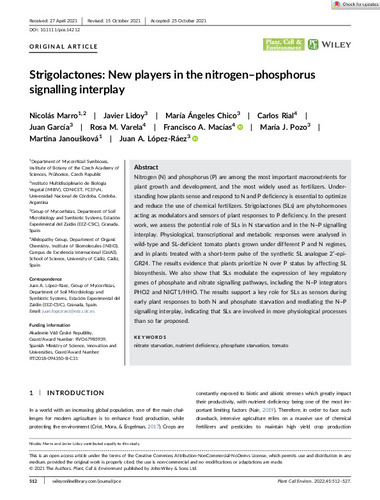
Nitrogen (N) and phosphorus (P) are among the most important macronutrients for plant growth and development, and the most widely used as fertilizers. Understanding how plants sense and respond to N and P deficiency is essential to optimize and reduce the use of chemical fertilizers. Strigolactones (SLs) are phytohormones acting as modulators and sensors of plant responses to P deficiency. In the present work, we assess the potential role of SLs in N starvation and in the N-P signalling interplay. Physiological, transcriptional and metabolic responses were analysed in wild-type and SL-deficient tomato plants grown under different P and N regimes, and in plants treated with a short-term pulse of the synthetic SL analogue 2 '-epi-GR24. The results evidence that plants prioritize N over P status by affecting SL biosynthesis. We also show that SLs modulate the expression of key regulatory genes of phosphate and nitrate signalling pathways, including the N-P integrators PHO2 and NIGT1/HHO. The results support a key role for SLs as sensors during early plant responses to both N and phosphate starvation and mediating the N-P signalling interplay, indicating that SLs are involved in more physiological processes than so far proposed.
Collections
- Artículos Científicos [11595]
- Artículos Científicos INBIO [413]
- Articulos Científicos Quim. Org. [320]

This work is under a Creative Commons License Attribution-NonCommercial-NoDerivatives 4.0 Internacional