INTERGROWTH-21st versus a customized method for the prediction of neonatal nutritional status in hypertensive disorders of pregnancy
Identificadores
URI: http://hdl.handle.net/10498/26561
DOI: 10.1186/s12884-022-04450-3
ISSN: 1471-2393
Files
Statistics
Metrics and citations
Export





Metadata
Show full item record
Date
2022-02Source
BMC Pregnancy and Childbirth, Vol. 22, Núm. 1Abstract
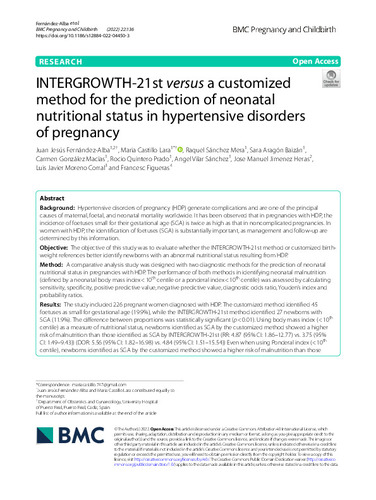
Background Hypertensive disorders of pregnancy (HDP) generate complications and are one of the principal causes of maternal, foetal, and neonatal mortality worldwide. It has been observed that in pregnancies with HDP, the incidence of foetuses small for their gestational age (SGA) is twice as high as that in noncomplicated pregnancies. In women with HDP, the identification of foetuses (SGA) is substantially important, as management and follow-up are determined by this information. Objective The objective of this study was to evaluate whether the INTERGROWTH-21st method or customized birthweight references better identify newborns with an abnormal nutritional status resulting from HDP. Method A comparative analysis study was designed with two diagnostic methods for the prediction of neonatal nutritional status in pregnancies with HDP. The performance of both methods in identifying neonatal malnutrition (defined by a neonatal body mass index < 10(th) centile or a ponderal index < 10(th) centile) was assessed by calculating sensitivity, specificity, positive predictive value, negative predictive value, diagnostic odds ratio, Youden's index and probability ratios. Results The study included 226 pregnant women diagnosed with HDP. The customized method identified 45 foetuses as small for gestational age (19.9%), while the INTERGROWTH-21st method identified 27 newborns with SGA (11.9%). The difference between proportions was statistically significant (p < 0.01). Using body mass index (< 10(th) centile) as a measure of nutritional status, newborns identified as SGA by the customized method showed a higher risk of malnutrition than those identified as SGA by INTERGROWTH-21st (RR: 4.87 (95% CI: 1.86-12.77) vs. 3.75 (95% CI: 1.49-9.43)) (DOR: 5.56 (95% CI: 1.82-16.98) vs. 4.84 (95% CI: 1.51-15.54)) Even when using Ponderal index (< 10(th) centile), newborns identified as SGA by the customized method showed a higher risk of malnutrition than those identified as SGA by INTERGROWTH-21st (RR 2.37 (95% CI: 1.11-5.05) vs. 1.68 (95% CI: 0.70-4.03))(DOR 2.62 (95% CI: 1.00-6.87) vs. 1.90 (95% CI: 0.61-5.92)). Conclusion In pregnant women with HDP, the predictive ability of the customized foetal growth curves to identify neonatal malnutrition appears to surpass that of INTERGROWTH-21st.
Collections
- Artículos Científicos [11595]
- Articulos Científicos Enf. Fisio. [313]
- Artículos Científicos INIBICA [1046]
- Articulos Científicos Mat. Inf. Rad. [129]

This work is under a Creative Commons License Atribución 4.0 Internacional