• español
    • English
  • Login
  • English 
    • español
    • English

UniversidaddeCádiz

Área de Biblioteca, Archivo y Publicaciones
Communities and Collections
View Item 
  •   RODIN Home
  • Producción Científica
  • Artículos Científicos
  • View Item
  •   RODIN Home
  • Producción Científica
  • Artículos Científicos
  • View Item
JavaScript is disabled for your browser. Some features of this site may not work without it.

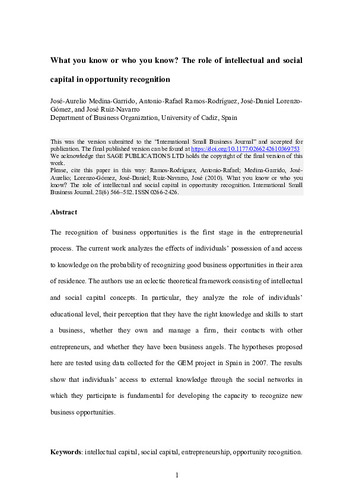
What you know or who you know? The role of intellectual and social capital in opportunity recognition
Thumbnail
Identificadores

URI: http://hdl.handle.net/10498/29605

DOI: 10.1177/0266242610369753

ISSN: 0266-2426

ISSN: 1741-2870

Files
2010 Ramos-Rodríguez et al. - 2010 - What you know or who you know The role of intellectual and social capital in opportunity recognition- Accepted version.pdf (471.5Kb)
Statistics
View statistics
Metrics and citations
 
Share
Export
Export reference to MendeleyRefworksEndNoteBibTexRIS
Metadata
Show full item record
Author/s
Ramos Rodríguez, Antonio RafaelAuthority UCA; Medina Garrido, José AurelioAuthority UCA; Lorenzo Gómez, José DanielAuthority UCA; Ruiz Navarro, José
Date
2010
Department
Organización de Empresas
Source
Ramos-Rodríguez, Antonio-Rafael; Medina-Garrido, José-Aurelio; Lorenzo-Gómez, José-Daniel; Ruiz-Navarro, José (2010). What you know or who you know? The role of intellectual and social capital in opportunity recognition. International Small Business Journal. 28(6) 566–582. ISSN 0266-2426. doi: 10.1177/0266242610369753
Abstract
The recognition of business opportunities is the first stage in the entrepreneurial process. The current work analyzes the effects of individuals’ possession of and access to knowledge on the probability of recognizing good business opportunities in their area of residence. The authors use an eclectic theoretical framework consisting of intellectual and social capital concepts. In particular, they analyze the role of individuals’ educational level, their perception that they have the right knowledge and skills to start a business, whether they own and manage a firm, their contacts with other entrepreneurs, and whether they have been business angels. The hypotheses proposed here are tested using data collected for the GEM project in Spain in 2007. The results show that individuals’ access to external knowledge through the social networks in which they participate is fundamental for developing the capacity to recognize new business opportunities.
Subjects
intellectual capital; social capital; entrepreneurship; opportunity recognition
Collections
  • Artículos Científicos [11777]
  • Articulos Científicos Org. Emp. [280]
Attribution-NonCommercial-NoDerivatives 4.0 Internacional
This work is under a Creative Commons License Attribution-NonCommercial-NoDerivatives 4.0 Internacional

Browse

All of RODINCommunities and CollectionsBy Issue DateAuthorsTitlesSubjectsThis CollectionBy Issue DateAuthorsTitlesSubjects

My Account

LoginRegister

Statistics

View Usage Statistics

Información adicional

AboutDeposit in RODINPoliciesGuidelinesRightsLinksStatisticsNewsFrequently Asked Questions

RODIN is available through

OpenAIREOAIsterRecolectaHispanaEuropeanaBaseDARTOATDGoogle Academic

Related links

Sherpa/RomeoDulcineaROAROpenDOARCreative CommonsORCID

RODIN está gestionado por el Área de Biblioteca, Archivo y Publicaciones de la Universidad de Cádiz

Contact informationSuggestionsUser Support

