Effects of a concurrent exercise training program on low back and sciatic pain and pain disability in late pregnancy
Statistics
Metrics and citations
Export





Metadata
Show full item record
Date
2023-03-17Source
Scandinavian Journal of Medicine and Science in Sports. Vol. 33, nº 7, July 2023, pp. 1201 - 1210Abstract
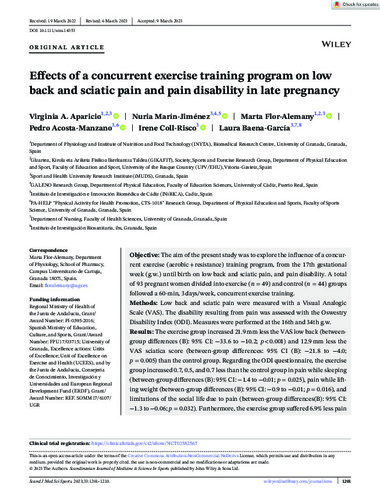
Objective: The aim of the present study was to explore the influence of a concurrent exercise (aerobic + resistance) training program, from the 17th gestational week (g.w.) until birth on low back and sciatic pain, and pain disability. A total of 93 pregnant women divided into exercise (n = 49) and control (n = 44) groups followed a 60-min, 3 days/week, concurrent exercise training. Methods: Low back and sciatic pain were measured with a Visual Analogic Scale (VAS). The disability resulting from pain was assessed with the Oswestry Disability Index (ODI). Measures were performed at the 16th and 34th g.w. Results: The exercise group increased 21.9 mm less the VAS low back (between-group differences (B): 95% CI: −33.6 to −10.2; p < 0.001) and 12.9 mm less the VAS sciatica score (between-group differences: 95% CI (B): −21.8 to −4.0; p = 0.005) than the control group. Regarding the ODI questionnaire, the exercise group increased 0.7, 0.5, and 0.7 less than the control group in pain while sleeping (between-group differences (B): 95% CI: −1.4 to −0.01; p = 0.025), pain while lifting weight (between-group differences (B): 95% CI: −0.9 to −0.01; p = 0.016), and limitations of the social life due to pain (between-group differences(B): 95% CI: −1.3 to −0.06; p = 0.032). Furthermore, the exercise group suffered 6.9% less pain than the control group in the ODI total score (between-group differences (B): 95% CI: −13.9 to 0.053; p = 0.052). Conclusion: This concurrent exercise training program adapted to pregnant women improved pain compared to controls.
Collections
- Artículos Científicos [11777]
- Articulos Científicos Did. E. Fis. [455]
- Artículos Científicos INIBICA [1083]

This work is under a Creative Commons License Attribution-NonCommercial-NoDerivatives 4.0 Internacional