Higher daytime systolic BP, prepregnancy BMI and an elevated sFlt-1/PlGF ratio predict the development of hypertension in normotensive pregnant women
Identificadores
URI: http://hdl.handle.net/10498/29730
DOI: 10.1186/s12958-022-01050-w
ISSN: 1477-7827
Statistics
Metrics and citations
Export





Metadata
Show full item record
Date
2022-12-23Source
Reproductive Biology and Endocrinology. Vol. 20, nº 1, December 2022, 175Abstract
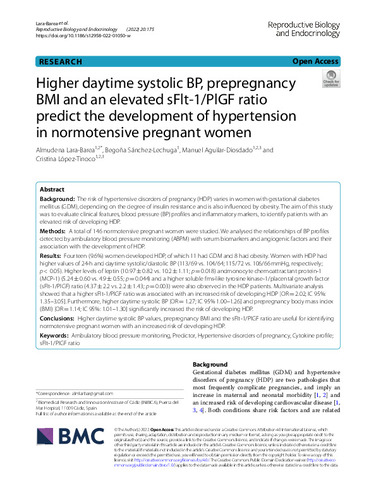
Background: The risk of hypertensive disorders of pregnancy (HDP) varies in women with gestational diabetes mellitus (GDM), depending on the degree of insulin resistance and is also influenced by obesity. The aim of this study was to evaluate clinical features, blood pressure (BP) profiles and inflammatory markers, to identify patients with an elevated risk of developing HDP. Methods: A total of 146 normotensive pregnant women were studied. We analysed the relationships of BP profiles detected by ambulatory blood pressure monitoring (ABPM) with serum biomarkers and angiogenic factors and their association with the development of HDP. Results: Fourteen (9.6%) women developed HDP, of which 11 had GDM and 8 had obesity. Women with HDP had higher values of 24-h and daytime systolic/diastolic BP (113/69 vs. 104/64; 115/72 vs. 106/66 mmHg, respectively; p < 0.05). Higher levels of leptin (10.97 ± 0.82 vs. 10.2 ± 1.11; p = 0.018) andmonocyte chemoattractant protein-1 (MCP-1) (5.24 ± 0.60 vs. 4.9 ± 0.55; p = 0.044) and a higher soluble fms-like tyrosine kinase-1/placental growth factor (sFlt-1/PlGF) ratio (4.37 ± 2.2 vs. 2.2 ± 1.43; p = 0.003) were also observed in the HDP patients. Multivariate analysis showed that a higher sFlt-1/PlGF ratio was associated with an increased risk of developing HDP [OR = 2.02; IC 95%: 1.35–3.05]. Furthermore, higher daytime systolic BP [OR = 1.27; IC 95% 1.00–1.26] and prepregnancy body mass index (BMI) [OR = 1.14; IC 95%: 1.01–1.30] significantly increased the risk of developing HDP. Conclusions: Higher daytime systolic BP values, prepregnancy BMI and the sFlt-1/PlGF ratio are useful for identifying normotensive pregnant women with an increased risk of developing HDP.
Collections
- Artículos Científicos [11777]
- Artículos Científicos INIBICA [1083]
- Articulos Científicos Medicina [297]

This work is under a Creative Commons License Atribución 4.0 Internacional