• español
    • English
  • Login
  • English 
    • español
    • English

UniversidaddeCádiz

Área de Biblioteca, Archivo y Publicaciones
Communities and Collections
View Item 
  •   RODIN Home
  • Producción Científica
  • Artículos Científicos
  • View Item
  •   RODIN Home
  • Producción Científica
  • Artículos Científicos
  • View Item
JavaScript is disabled for your browser. Some features of this site may not work without it.

A Stretch of Negatively Charged Amino Acids of Linker for Activation of T-Cell Adaptor Has a Dual Role in T-Cell Antigen Receptor Intracellular Signaling
Thumbnail
Identificadores

URI: http://hdl.handle.net/10498/30352

DOI: 10.3389/fimmu.2018.00115

ISSN: 1664-3224

Files
Artículo (2.399Mb)
Statistics
View statistics
Metrics and citations
 
Share
Export
Export reference to MendeleyRefworksEndNoteBibTexRIS
Metadata
Show full item record
Author/s
Martínez de Arbulo Echevarría, MiguelAuthority UCA; Narbona Sánchez, IsaacAuthority UCA; Fernández Ponce, Cecilia MatildeAuthority UCA; Vico Barranco, InmaculadaAuthority UCA; Rueda-Ygueravide, María Dolores; Dustin, Michael L.; Miazek, Arkadiusz; Durán Ruiz, María del CarmenAuthority UCA; García Cózar, Francisco JoséAuthority UCA; Aguado Vidal, EnriqueAuthority UCA
Date
2018-02-02
Department
Biomedicina, Biotecnología y Salud Pública
Source
Frontiers in Immunology - 2018, Vol. 2:9:115
Abstract
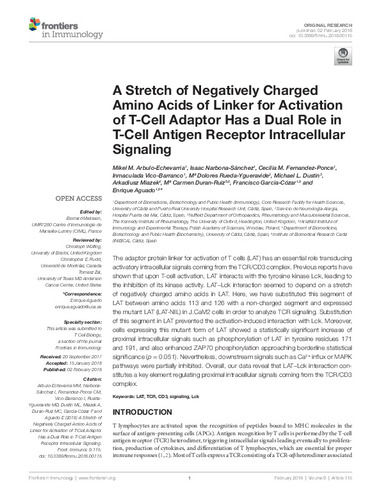
The adaptor protein linker for activation of T cells (LAT) has an essential role transducing activatory intracellular signals coming from the TCR/CD3 complex. Previous reports have shown that upon T-cell activation, LAT interacts with the tyrosine kinase Lck, leading to the inhibition of its kinase activity. LAT-Lck interaction seemed to depend on a stretch of negatively charged amino acids in LAT. Here, we have substituted this segment of LAT between amino acids 113 and 126 with a non-charged segment and expressed the mutant LAT (LAT-NIL) in J.CaM2 cells in order to analyze TCR signaling. Substitution of this segment in LAT prevented the activation-induced interaction with Lck. Moreover, cells expressing this mutant form of LAT showed a statistically significant increase of proximal intracellular signals such as phosphorylation of LAT in tyrosine residues 171 and 191, and also enhanced ZAP70 phosphorylation approaching borderline statistical significance (p = 0.051). Nevertheless, downstream signals such as Ca2+ influx or MAPK pathways were partially inhibited. Overall, our data reveal that LAT-Lck interaction constitutes a key element regulating proximal intracellular signals coming from the TCR/CD3 complex.
Subjects
CD3; LAT; Lck; TCR; signaling
Collections
  • Artículos Científicos [11968]
  • Articulos Científicos Biomedicina [582]
  • Artículos Científicos INIBICA [1093]
Attribution-NonCommercial-NoDerivatives 4.0 Internacional
This work is under a Creative Commons License Attribution-NonCommercial-NoDerivatives 4.0 Internacional

Browse

All of RODINCommunities and CollectionsBy Issue DateAuthorsTitlesSubjectsThis CollectionBy Issue DateAuthorsTitlesSubjects

My Account

LoginRegister

Statistics

View Usage Statistics

Información adicional

AboutDeposit in RODINPoliciesGuidelinesRightsLinksStatisticsNewsFrequently Asked Questions

RODIN is available through

OpenAIREOAIsterRecolectaHispanaEuropeanaBaseDARTOATDGoogle Academic

Related links

Sherpa/RomeoDulcineaROAROpenDOARCreative CommonsORCID

RODIN está gestionado por el Área de Biblioteca, Archivo y Publicaciones de la Universidad de Cádiz

Contact informationSuggestionsUser Support

