The shape of cancer relapse: Topological data analysis predicts recurrence in paediatric acute lymphoblastic leukaemia





Metadata
Show full item recordAuthor/s
Chulian García, Salvador ; Stolz, Bernadette J.; Martínez Rubio, Álvaro; Blázquez, Cristina; Rodríguez‑Gutiérrez, Juan Francisco; Caballero-Velázquez, Teresa; Molinos Quintana, Águeda; Ramírez-Orellana, Manuel; Castillo Robleda, Ana; Fuster Soler, Luis; Minguela Puras, Alfredo; Martínez-Sánchez, María V.; Rosa Durán, María; Pérez-García, Víctor M.; Byrne, Helen M.
Date
2023-08Source
PLOS Computational Biology, 19(8), e1011329Abstract
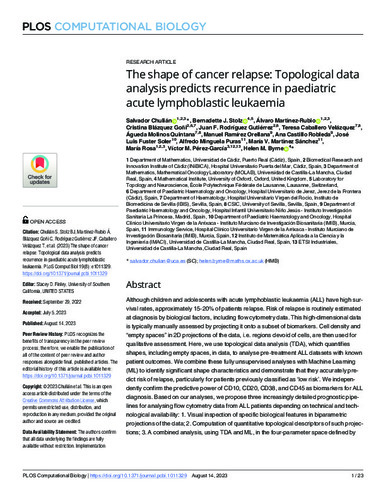
Although children and adolescents with acute lymphoblastic leukaemia (ALL) have high sur- vival rates, approximately 15-20% of patients relapse. Risk of relapse is routinely estimated at diagnosis by biological factors, including flow cytometry data. This high-dimensional data is typically manually assessed by projecting it onto a subset of biomarkers. Cell density and “empty spaces” in 2D projections of the data, i.e. regions devoid of cells, are then used for qualitative assessment. Here, we use topological data analysis (TDA), which quantifies shapes, including empty spaces, in data, to analyse pre-treatment ALL datasets with known patient outcomes. We combine these fully unsupervised analyses with Machine Learning (ML) to identify significant shape characteristics and demonstrate that they accurately pre- dict risk of relapse, particularly for patients previously classified as ‘low risk’. We indepen- dently confirm the predictive power of CD10, CD20, CD38, and CD45 as biomarkers for ALL diagnosis. Based on our analyses, we propose three increasingly detailed prognostic pipe- lines for analysing flow cytometry data from ALL patients depending on technical and tech- nological availability: 1. Visual inspection of specific biological features in biparametric projections of the data; 2. Computation of quantitative topological descriptors of such projec- tions; 3. A combined analysis, using TDA and ML, in the four-parameter space defined by CD10, CD20, CD38 and CD45. Our analyses readily extend to other haematological malignancies.
Collections
- Artículos Científicos [11595]
- Articulos Científicos Matemáticas [506]