Correction to: On statistical convergence and strong Cesàro convergence by moduli for double sequences (Journal of Inequalities and Applications, (2022), 2022, 1, (62), 10.1186/s13660-022-02799-9)
Identificadores
URI: http://hdl.handle.net/10498/32065
DOI: 10.1186/S13660-023-02987-1
ISSN: 1029-242X
ISSN: 1025-5834
Statistics
Metrics and citations
Export





Metadata
Show full item recordDate
2023Source
Journal of Inequalities and ApplicationsAbstract
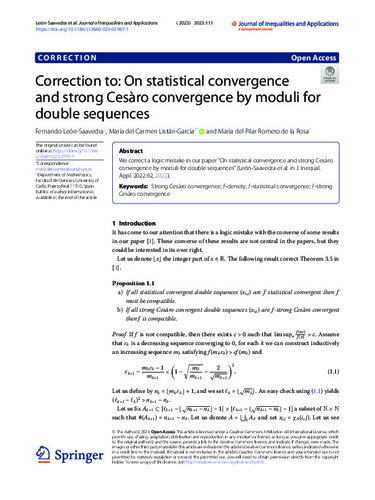
It has come to our attention that there is a logic mistake with the converse of some results in our paper [1]. These converse of these results are not central in the papers, but they could be interested in its own right. Let us denote (Formula presented.) the integer part of (Formula presented.). The following result correct Theorem 3.5 in [1]. If all statistical convergent double sequences (Formula presented.) arefstatistical convergent thenfmust be compatible. If all strong Cesàro convergent double sequences (Formula presented.) aref-strong Cesàro convergent thenfis compatible. If f is not compatible, then there exists (Formula presented.) such that (Formula presented.). Assume that (Formula presented.) is a decreasing sequence converging to 0, for each k we can construct inductively an increasing sequence (Formula presented.) satisfying (Formula presented.) and (Formula presented.) Let us define by (Formula presented.) , and we set (Formula presented.). An easy check using (1.1) yields (Formula presented.). Let us fix (Formula presented.) a subset of (Formula presented.) such that (Formula presented.). Let us denote (Formula presented.) and set (Formula presented.). Let us see that (Formula presented.) is statistically convergent to 0, but not f-statistically convergent. Indeed, for any (Formula presented.) , there exist p and q, such that (Formula presented.) and (Formula presented.). Set (Formula presented.). We can suppose without loss that (Formula presented.). Hence, since (Formula presented.) , for any (Formula presented.) : (Formula presented.) which goes to zero as (Formula presented.) as desired. On the other hand, if we set (Formula presented.) we shall show that there exists ε such that the limit (Formula presented.) is not zero. Indeed, (Formula presented.) which gives that (Formula presented.) On the other hand, for each p, q there exists (Formula presented.) , (Formula presented.) such that (Formula presented.) and (Formula presented.). Set (Formula presented.). Since (Formula presented.) , we get that for any (Formula presented.) (Formula presented.) which yields part a). Again the part b) is the same proof. □ The next result fixed the converse of Theorem 3.7 in [1]. If allf-strong Cesàro convergent double sequences aref-statistically and bounded thenfmust be compatible. If f is not compatible then there exist two sequences (Formula presented.) , (Formula presented.) satisfying (Formula presented.) for some (Formula presented.). We set (Formula presented.) , we can select (Formula presented.) inductively, such that the sequence (Formula presented.) is decreasing and converges to zero. Again it is direct to show that (Formula presented.) is f-statistically convergent to zero, but not f-strong Cesàro convergent. □ Let us recall that f is a compatible modulus function provided (Formula presented.). We will say that a modulus function fis compatible of second order or 2-compatible, provided (Formula presented.). Clearly, if f is compatible, then f is 2-compatible. The next result correct Theorem 2.6 in [1]. Assume that for anyf-statistical convergent double sequence (Formula presented.) we have that for any (Formula presented.) (Formula presented.) thenfmust be 2-compatible. Indeed, assume that f is not compatible. Let (Formula presented.) be a decreasing sequence converging to 0. Since f is not compatible, there exists (Formula presented.) such that, for each k, there exists (Formula presented.) such that (Formula presented.). Moreover, we can select (Formula presented.) inductively satisfying (Formula presented.) Now we use an standard argument used to construct subsets with prescribed densities. Set (Formula presented.). And extracting a subsequence if it is necessary, we can assume that (Formula presented.) , (Formula presented.) . Thus, set (Formula presented.). Condition (1.2) guarantee that (Formula presented.). Let us denote (Formula presented.) , and (Formula presented.). An easy check show that the sequence (Formula presented.) is f-statistical convergent to zero, but (Formula presented.) which yields the desired result. □ It is worthy to find a 2-compatible function that is not compatible, and to improve Proposition 1.3 replacing 2-compatibility by compatibility. The corrections have been indicated in this article and the original article [1] has been corrected.
Collections
- Artículos Científicos [11777]
- Articulos Científicos Matemáticas [512]

This work is under a Creative Commons License Attribution 4.0 Internacional
Related items
Showing items related by title, author, creator and subject.
-
On f-strongly Cesàro and f-statistical derivable functions
Altay, Bilal; García Pacheco, Francisco Javier (AMER INST MATHEMATICAL SCIENCES-AIMS, 2022)
-
On set-convergence statistically modulated
Romero de la Rosa, María Pilar (Springer, 2025-07-22)