• español
    • English
  • Login
  • English 
    • español
    • English

UniversidaddeCádiz

Área de Biblioteca, Archivo y Publicaciones
Communities and Collections
View Item 
  •   RODIN Home
  • Producción Científica
  • Artículos Científicos
  • View Item
  •   RODIN Home
  • Producción Científica
  • Artículos Científicos
  • View Item
JavaScript is disabled for your browser. Some features of this site may not work without it.

Collective hydrogen stand-alone renewable energy systems for buildings in Spain. Towards the self-sufficiency
Thumbnail
Identificadores

URI: http://hdl.handle.net/10498/32581

DOI: 10.1016/j.ijhydene.2024.05.438

ISSN: 0360-3199

Files
Finalversion.pdf (6.982Mb)
Statistics
View statistics
Metrics and citations
 
Share
Export
Export reference to MendeleyRefworksEndNoteBibTexRIS
Metadata
Show full item record
Author/s
Gil Mena, Antonio JoséAuthority UCA; Abderraouf, Bouakkaz; Abelleira Pereira, José MaríaAuthority UCA; Segovia Guerrero, LuisAuthority UCA; Martín Rodríguez, María de la LuzAuthority UCA
Date
2024-06-27
Department
Ingeniería Eléctrica; Ingeniería Industrial e Ingeniería Civil; Ingeniería Química y Tecnología de Alimentos
Source
International Journal of Hydrogen Energy Volume 72, 27 June 2024, Pages 1274-1286
Abstract
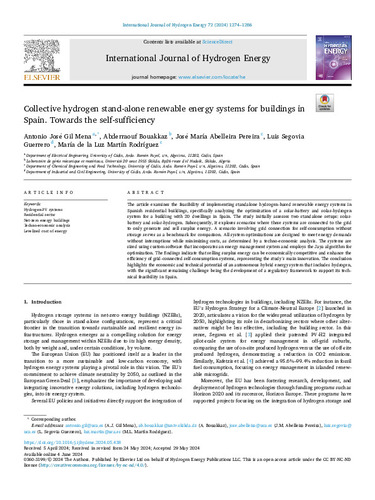
The article examines the feasibility of implementing standalone hydrogen-based renewable energy systems in Spanish residential buildings, specifically analyzing the optimization of a solar-battery and solar-hydrogen system for a building with 20 dwellings in Spain. The study initially assesses two standalone setups: solar-battery and solar-hydrogen. Subsequently, it explores scenarios where these systems are connected to the grid to only generate and sell surplus energy. A scenario involving grid connection for self-consumption without storage serves as a benchmark for comparison. All system optimizations are designed to meet energy demands without interruptions while minimizing costs, as determined by a techno-economic analysis. The systems are sized using custom software that incorporates an energy management system and employs the Jaya algorithm for optimization. The findings indicate that selling surplus energy can be economically competitive and enhance the efficiency of grid-connected self-consumption systems, representing the study's main innovation. The conclusion highlights the economic and technical potential of an autonomous hybrid energy system that includes hydrogen, with the significant remaining challenge being the development of a regulatory framework to support its technical feasibility in Spain.
Subjects
Hydrogen-PV systems; Residential sector; Net-zero energy buildings; Techno-economic analysis; Levelized cost of energy
Collections
  • Artículos Científicos [11777]
  • Artículos Científicos IMEYMAT [565]
  • Articulos Científicos Ing. Elec. [79]
  • Articulos Científicos Ing. Ind. [93]
  • Articulos Científicos Ing. Quim. [308]

Browse

All of RODINCommunities and CollectionsBy Issue DateAuthorsTitlesSubjectsThis CollectionBy Issue DateAuthorsTitlesSubjects

My Account

LoginRegister

Statistics

View Usage Statistics

Información adicional

AboutDeposit in RODINPoliciesGuidelinesRightsLinksStatisticsNewsFrequently Asked Questions

RODIN is available through

OpenAIREOAIsterRecolectaHispanaEuropeanaBaseDARTOATDGoogle Academic

Related links

Sherpa/RomeoDulcineaROAROpenDOARCreative CommonsORCID

RODIN está gestionado por el Área de Biblioteca, Archivo y Publicaciones de la Universidad de Cádiz

Contact informationSuggestionsUser Support

