Converting carbon black into an efficient and multi-site ORR electrocatalyst: the importance of bottom-up construction parameters
Identificadores
URI: http://hdl.handle.net/10498/32607
DOI: 10.1039/d3nr04244h
ISSN: 2040-3372
ISSN: 2040-3364
Statistics
Metrics and citations
Export





Metadata
Show full item record
Date
2023Source
Nanoscale - 2023, Vol. 15, n.46, pp. 18592-18602Abstract
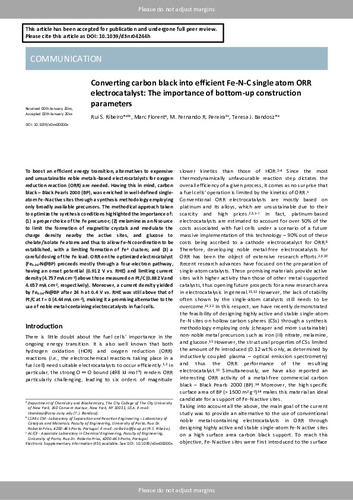
To boost efficient energy transitions, alternatives to expensive and unsustainable noble metal-based electrocatalysts for the oxygen reduction reaction (ORR) are needed. Having this in mind, carbon black - Black Pearls 2000 (BP) was enriched in active nitrogen-containing centers, including single-atom Fe-N sites surrounded by Fe nanoclusters, through a synthesis methodology employing only broadly available precursors. The methodical approach taken to optimize the synthesis conditions highlighted the importance of (1) a proper choice of the Fe precursor; (2) melamine as an N source to limit the formation of magnetite crystals and modulate the charge density nearby the active sites, and glucose to chelate/isolate Fe atoms and thus allow the Fe-N coordination to be established, with a limiting formation of Fe0 clusters; and (3) a careful dosing of the Fe load. The ORR on the optimized electrocatalyst (Fe0.06-N@BP) proceeds mostly through a four-electron pathway, having an onset potential (0.912 V vs. RHE) and limiting current density (4.757 mA cm−2) above those measured on Pt/C (0.882 V and 4.657 mA cm−2, respectively). Moreover, the current density yielded by Fe0.06-N@BP after 24 h at 0.4 V vs. RHE was still above that of Pt/C at t = 0 (4.44 mA cm−2), making it a promising alternative to noble metal-containing electrocatalysts in fuel cells.
Collections
- Artículos Científicos [11777]
- Articulos Científicos CC. Mat. [566]
- Artículos Científicos IMEYMAT [565]

This work is under a Creative Commons License Atribución 4.0 Internacional