Hyperspectral technology for oil spills characterisation by using feature selection
Identificadores
URI: http://hdl.handle.net/10498/32806
DOI: 10.1016/J.TRPRO.2023.11.065
ISSN: 2352-1465
ISSN: 2352-1457
Ficheros
Estadísticas
Métricas y Citas
Exportar a





Metadatos
Mostrar el registro completo del ítem
Fecha
2023Fuente
Transportation Research Procedia 71 (2023) 117–123Resumen
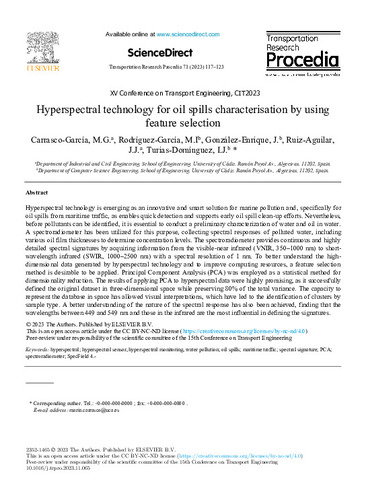
Hyperspectral technology is emerging as an innovative and smart solution for marine pollution and, specifically for oil spills from maritime traffic, as enables quick detection and supports early oil spill clean-up efforts. Nevertheless, before pollutants can be identified, it is essential to conduct a preliminary characterization of water and oil in water. A spectroradiometer has been utilized for this purpose, collecting spectral responses of polluted water, including various oil film thicknesses to determine concentration levels. The spectroradiometer provides continuous and highly detailed spectral signatures by acquiring information from the visible-near infrared (VNIR, 350-1000 nm) to short-wavelength infrared (SWIR, 1000-2500 nm) with a spectral resolution of 1 nm. To better understand the high-dimensional data generated by hyperspectral technology and to improve computing resources, a feature selection method is desirable to be applied. Principal Component Analysis (PCA) was employed as a statistical method for dimensionality reduction. The results of applying PCA to hyperspectral data were highly promising, as it successfully defined the original dataset in three-dimensional space while preserving 80% of the total variance. The capacity to represent the database in space has allowed visual interpretations, which have led to the identification of clusters by sample type. A better understanding of the nature of the spectral response has also been achieved, finding that the wavelengths between 449 and 549 nm and those in the infrared are the most influential in defining the signatures.
Colecciones

Esta obra está bajo una Licencia Creative Commons Attribution-NonCommercial-NoDerivatives 4.0 Internacional