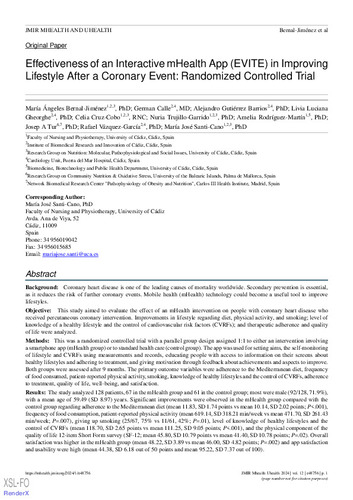
Effectiveness of an Interactive mHealth App (EVITE) in Improving Lifestyle After a Coronary Event: Randomized Controlled Trial
Statistics
Metrics and citations
Export





Metadata
Show full item record
Date
2024Source
JMIR mHealth and uHealth - 2024, Vol. 12 n.1Abstract
Background: Coronary heart disease is one of the leading causes of mortality worldwide. Secondary prevention is essential, as it reduces the risk of further coronary events. Mobile health (mHealth) technology could become a useful tool to improve lifestyles. Objective: This study aimed to evaluate the effect of an mHealth intervention on people with coronary heart disease who received percutaneous coronary intervention. Improvements in lifestyle regarding diet, physical activity, and smoking; level of knowledge of a healthy lifestyle and the control of cardiovascular risk factors (CVRFs); and therapeutic adherence and quality of life were analyzed. Methods: This was a randomized controlled trial with a parallel group design assigned 1:1 to either an intervention involving a smartphone app (mHealth group) or to standard health care (control group). The app was used for setting aims, the self-monitoring of lifestyle and CVRFs using measurements and records, educating people with access to information on their screens about healthy lifestyles and adhering to treatment, and giving motivation through feedback about achievements and aspects to improve. Both groups were assessed after 9 months. The primary outcome variables were adherence to the Mediterranean diet, frequency of food consumed, patient-reported physical activity, smoking, knowledge of healthy lifestyles and the control of CVRFs, adherence to treatment, quality of life, well-being, and satisfaction. Results: The study analyzed 128 patients, 67 in the mHealth group and 61 in the control group; most were male (92/128, 71.9%), with a mean age of 59.49 (SD 8.97) years. Significant improvements were observed in the mHealth group compared with the control group regarding adherence to the Mediterranean diet (mean 11.83, SD 1.74 points vs mean 10.14, SD 2.02 points; P<.001), frequency of food consumption, patient-reported physical activity (mean 619.14, SD 318.21 min/week vs mean 471.70, SD 261.43 min/week; P=.007), giving up smoking (25/67, 75% vs 11/61, 42%; P=.01), level of knowledge of healthy lifestyles and the control of CVRFs (mean 118.70, SD 2.65 points vs mean 111.25, SD 9.05 points; P<.001), and the physical component of the quality of life 12-item Short Form survey (SF-12; mean 45.80, SD 10.79 points vs mean 41.40, SD 10.78 points; P=.02). Overall satisfaction was higher in the mHealth group (mean 48.22, SD 3.89 vs mean 46.00, SD 4.82 points; P=.002) and app satisfaction and usability were high (mean 44.38, SD 6.18 out of 50 points and mean 95.22, SD 7.37 out of 100). Conclusions: The EVITE app was effective in improving the lifestyle of patients in terms of adherence to the Mediterranean diet, frequency of healthy food consumption, physical activity, giving up smoking, knowledge of healthy lifestyles and controlling CVRFs, quality of life, and overall satisfaction. The app satisfaction and usability were excellent. © 2024 JMIR Publications Inc.. All rights reserved.
Collections
- Artículos Científicos [11595]
- Articulos Científicos Biomedicina [565]
- Articulos Científicos Enf. Fisio. [313]
- Artículos Científicos INIBICA [1046]

This work is under a Creative Commons License Atribución 4.0 Internacional