Sleep patterns are associated with cardiometabolic risk factors in nine-year-old Swedish children
Identificadores
URI: http://hdl.handle.net/10498/33696
DOI: 10.1111/APA.17254
ISSN: 1651-2227
ISSN: 0803-5253
Statistics
Metrics and citations
Export





Metadata
Show full item record
Date
2024Source
Acta Paediatrica, International Journal of Paediatrics, Vol. 113, Núm. 8, 2024, pp. 1891-1899Abstract
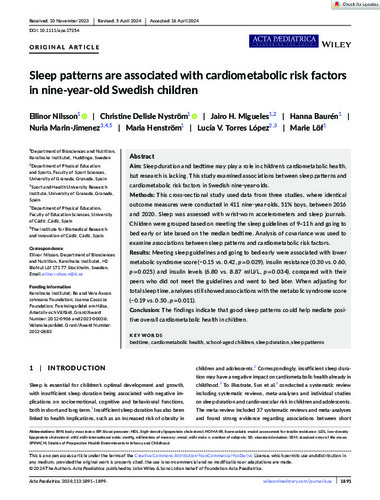
Aim: Sleep duration and bedtime may play a role in children's cardiometabolic health, but research is lacking. This study examined associations between sleep patterns and cardiometabolic risk factors in Swedish nine-year-olds. Methods: This cross-sectional study used data from three studies, where identical outcome measures were conducted in 411 nine-year-olds, 51% boys, between 2016 and 2020. Sleep was assessed with wrist-worn accelerometers and sleep journals. Children were grouped based on meeting the sleep guidelines of 9–11 h and going to bed early or late based on the median bedtime. Analysis of covariance was used to examine associations between sleep patterns and cardiometabolic risk factors. Results: Meeting sleep guidelines and going to bed early were associated with lower metabolic syndrome score (−0.15 vs. 0.42, p = 0.029), insulin resistance (0.30 vs. 0.60, p = 0.025) and insulin levels (6.80 vs. 8.87 mIU/L, p = 0.034), compared with their peers who did not meet the guidelines and went to bed later. When adjusting for total sleep time, analyses still showed associations with the metabolic syndrome score (−0.19 vs. 0.50, p = 0.011). Conclusion: The findings indicate that good sleep patterns could help mediate positive overall cardiometabolic health in children.
Collections
- Artículos Científicos [11777]
- Articulos Científicos Did. E. Fis. [455]
- Artículos Científicos INIBICA [1083]

This work is under a Creative Commons License Attribution-NonCommercial-NoDerivatives 4.0 Internacional