An enhanced hybrid interval slacks-based DEA model with super-efficiency and application
Identificadores
URI: http://hdl.handle.net/10498/35931
DOI: 10.1007/s40314-024-03007-8
ISSN: 1807-0302
ISSN: 2238-3603
Statistics
Metrics and citations
Export





Metadata
Show full item record
Date
2024-12-12Source
Computational and Applied Mathematics, Vol. 44, Núm. 1, 2025Abstract
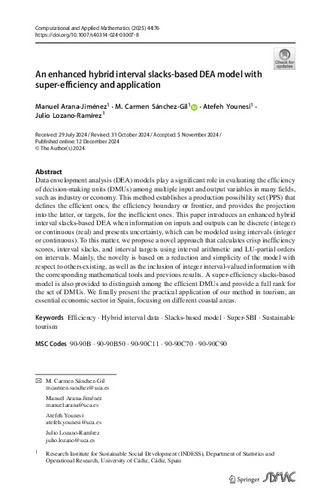
Data envelopment analysis (DEA) models play a significant role in evaluating the efficiency
of decision-making units (DMUs) among multiple input and output variables in many fields,
such as industry or economy. This method establishes a production possibility set (PPS) that
defines the efficient ones, the efficiency boundary or frontier, and provides the projection
into the latter, or targets, for the inefficient ones. This paper introduces an enhanced hybrid
interval slacks-based DEA when information on inputs and outputs can be discrete (integer)
or continuous (real) and presents uncertainty, which can be modeled using intervals (integer
or continuous). To this matter, we propose a novel approach that calculates crisp inefficiency
scores, interval slacks, and interval targets using interval arithmetic and LU-partial orders
on intervals. Mainly, the novelty is based on a reduction and simplicity of the model with
respect to others existing, as well as the inclusion of integer interval-valued information with
the corresponding mathematical tools and previous results. A super-efficiency slacks-based
model is also provided to distinguish among the efficient DMUs and provide a full rank for
the set of DMUs. We finally present the practical application of our method in tourism, an
essential economic sector in Spain, focusing on different coastal areas.
Collections
- Artículos Científicos [11777]
- Articulos Científicos Est. I.O. [354]
- Artículos Científicos INDESS [1015]

This work is under a Creative Commons License Attribution-NonCommercial-NoDerivatives 4.0 Internacional