Plastic ingestion in aquatic insects: Implications of waterbirds and landfills and association with stable isotopes
Identificadores
URI: http://hdl.handle.net/10498/36182
DOI: 10.1016/j.scitotenv.2024.176707
ISSN: 1879-1026
ISSN: 0048-9697
Statistics
Metrics and citations
Export





Metadata
Show full item record
Date
2024-10-08Source
Science of the Total Environment, Vol. 954, 2024Abstract
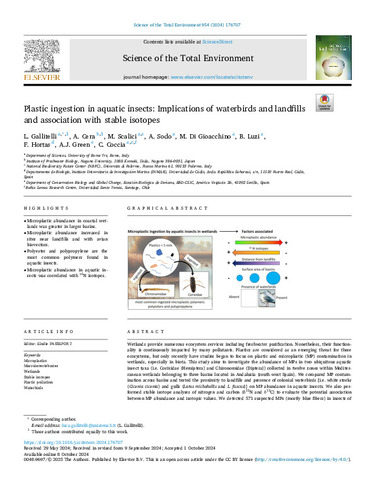
Wetlands provide numerous ecosystem services including freshwater purification. Nonetheless, their functionality is continuously impacted by many pollutants. Plastics are considered as an emerging threat for these
ecosystems, but only recently have studies began to focus on plastic and microplastic (MP) contamination in
wetlands, especially in biota. This study aims to investigate the abundance of MPs in two ubiquitous aquatic
insect taxa (i.e. Corixidae (Hemiptera) and Chironomidae (Diptera)) collected in twelve zones within Mediterranean wetlands belonging to three basins located in Andalusia (south-west Spain). We compared MP contamination across basins and tested the proximity to landfills and presence of colonial waterbirds [i.e. white storks
(Ciconia ciconia) and gulls (Larus michahellis and L. fuscus)] on MP abundance in aquatic insects. We also performed stable isotope analyses of nitrogen and carbon (δ15N and δ13C) to evaluate the potential association
between MP abundance and isotopic values. We detected 571 suspected MPs (mostly blue fibers) in insects of different developmental stages (i.e., larvae, pupae, nymphs and adults). Polyesters and polypropylene were the
most frequent polymers detected. The generalized linear mixed models indicated that MP abundance decreased
with increasing distance from landfills; but it also increased in sites with birds that fed on landfills and roost in
wetlands. When controlling for landfill effects, sites in the smallest basin (Guadalete) had lower MP contamination than those in Odiel-Tinto and the much larger (>15×) Guadalquivir. Moreover, we found a negative
association between MPs items/g (or mean MPs) and 15N isotopes in adult corixids. Our findings showed that MP
pollution is present in all the study areas, including strictly protected wetlands. The use of aquatic insects for
biomonitoring of MP pollution can help identify priority areas for management actions to mitigate plastic
pollution.
Collections
- Artículos Científicos [11777]
- Articulos Científicos Biología [857]

This work is under a Creative Commons License Attribution-NonCommercial-NoDerivatives 4.0 Internacional