Ghrelin mitigates β-cell mass loss during insulitis in an animal model of autoimmune diabetes mellitus, the BioBreeding/Worcester rat
Identificadores
URI: http://hdl.handle.net/10498/36629
DOI: 10.1002/DMRR.2813
ISSN: 1520-7560
ISSN: 1520-7552
Statistics
Metrics and citations
Export





Metadata
Show full item record
Date
2017Source
Diabetes/Metabolism Research and Reviews - 2017, Vol. 33 n. 1 pp. 1-13Abstract
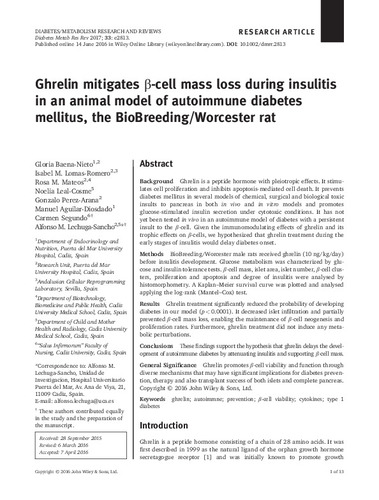
Background: Ghrelin is a peptide hormone with pleiotropic effects. It stimulates cell proliferation and inhibits apoptosis-mediated cell death. It prevents diabetes mellitus in several models of chemical, surgical and biological toxic insults to pancreas in both in vivo and in vitro models and promotes glucose-stimulated insulin secretion under cytotoxic conditions. It has not yet been tested in vivo in an autoimmune model of diabetes with a persistent insult to the β-cell. Given the immunomodulating effects of ghrelin and its trophic effects on β-cells, we hypothesized that ghrelin treatment during the early stages of insulitis would delay diabetes onset. Methods: BioBreeding/Worcester male rats received ghrelin (10 ng/kg/day) before insulitis development. Glucose metabolism was characterized by glucose and insulin tolerance tests. β-cell mass, islet area, islet number, β-cell clusters, proliferation and apoptosis and degree of insulitis were analysed by histomorphometry. A Kaplan–Meier survival curve was plotted and analysed applying the log-rank (Mantel–Cox) test. Results: Ghrelin treatment significantly reduced the probability of developing diabetes in our model (p < 0.0001). It decreased islet infiltration and partially prevented β-cell mass loss, enabling the maintenance of β-cell neogenesis and proliferation rates. Furthermore, ghrelin treatment did not induce any metabolic perturbations. Conclusions: These findings support the hypothesis that ghrelin delays the development of autoimmune diabetes by attenuating insulitis and supporting β-cell mass. General Significance: Ghrelin promotes β-cell viability and function through diverse mechanisms that may have significant implications for diabetes prevention, therapy and also transplant success of both islets and complete pancreas.
Collections

This work is under a Creative Commons License Attribution-NonCommercial-NoDerivatives 4.0 Internacional