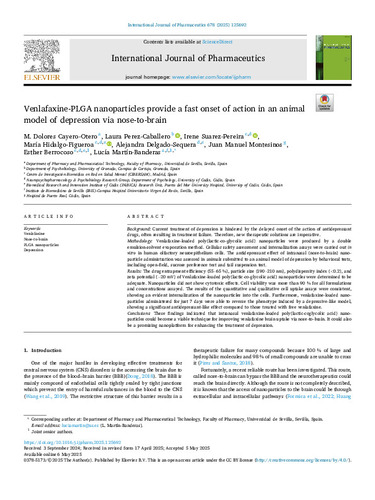
Venlafaxine-PLGA nanoparticles provide a fast onset of action in an animal model of depression via nose-to-brain
Identificadores
URI: http://hdl.handle.net/10498/36769
DOI: 10.1016/j.ijpharm.2025.125692
ISSN: 0378-5173
Statistics
Metrics and citations
Export





Metadata
Show full item record
Date
2025Source
International Journal of Pharmaceutics - 2025, Vol. 678Abstract
Background
Current treatment of depression is hindered by the delayed onset of the action of antidepressant drugs, often resulting in treatment failure. Therefore, new therapeutic solutions are imperative.
Methodology
Venlafaxine-loaded poly(lactic-co-glycolic acid) nanoparticles were produced by a double emulsion-solvent evaporation method. Cellular safety assessment and internalization assays were carried out in vitro in human olfactory neuroepithelium cells. The antidepressant effect of intranasal (nose-to-brain) nanoparticle administration was assessed in animals submitted to an animal model of depression by behavioral tests, including open-field, sucrose preference test and tail suspension test.
Results
The drug entrapment efficiency (55–65 %), particle size (190–210 nm), polydispersity index (<0.2), and zeta potential (−20 mV) of Venlafaxine-loaded poly(lactic-co-glycolic acid) nanoparticles were determined to be adequate. Nanoparticles did not show cytotoxic effects. Cell viability was more than 90 % for all formulations and concentrations assayed. The results of the quantitative and qualitative cell uptake assays were consistent, showing an evident internalization of the nanoparticles into the cells. Furthermore, venlafaxine-loaded nanoparticles administered for just 7 days were able to reverse the phenotype induced by a depressive-like model, showing a significant antidepressant-like effect compared to those treated with free venlafaxine.
Conclusions
These findings indicated that intranasal venlafaxine-loaded poly(lactic-coglycolic acid) nanoparticles could become a viable technique for improving venlafaxine brain uptake via nose-to-brain. It could also be a promising nanoplatform for enhancing the treatment of depression.
Collections

This work is under a Creative Commons License Attribution- 4.0 Internacional