• español
    • English
  • Login
  • English 
    • español
    • English

UniversidaddeCádiz

Área de Biblioteca, Archivo y Publicaciones
Communities and Collections
View Item 
  •   RODIN Home
  • Producción Científica
  • Artículos Científicos
  • View Item
  •   RODIN Home
  • Producción Científica
  • Artículos Científicos
  • View Item
JavaScript is disabled for your browser. Some features of this site may not work without it.

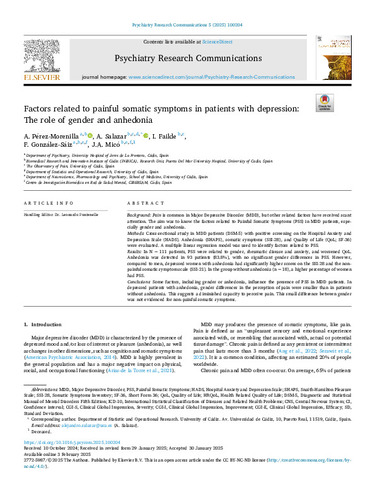
Factors related to painful somatic symptoms in patients with depression: The role of gender and anhedonia
Thumbnail
Identificadores

URI: http://hdl.handle.net/10498/37144

DOI: 10.1016/J.PSYCOM.2025.100204

ISSN: 2772-5987

Files
OA_2025_0263.pdf (636.2Kb)
Statistics
View statistics
Metrics and citations
 
Share
Export
Export reference to MendeleyRefworksEndNoteBibTexRIS
Metadata
Show full item record
Author/s
Pérez-Morenilla, A.; Salazar Couso, AlejandroAuthority UCA; Failde Martínez, InmaculadaAuthority UCA; González Saiz, Francisco ManuelAuthority UCA; Micó Segura, Juan AntonioAuthority UCA
Date
2025
Department
Biomedicina, Biotecnología y Salud Pública; Cirugía; Estadística e Investigación Operativa; Medicina; Neurociencias
Source
Psychiatry Research Communications - 2025, Vol.5 n.1
Abstract
Background: Pain is common in Major Depressive Disorder (MDD), but other related factors have received scant attention. The aim was to know the factors related to Painful Somatic Symptoms (PSS) in MDD patients, especially gender and anhedonia. Methods: Cross-sectional study in MDD patients (DSM-5) with positive screening on the Hospital Anxiety and Depression Scale (HADS). Anhedonia (SHAPS), somatic symptoms (SSI-28), and Quality of Life (QoL; SF-36) were evaluated. A multiple linear regression model was used to identify factors related to PSS. Results: In N = 111 patients, PSS were related to gender, rheumatic disease and anxiety, and worsened QoL. Anhedonia was detected in 93 patients (83.8%), with no significant gender differences in PSS. However, compared to men, depressed women with anhedonia had significantly higher scores on the SSI-28 and the non-painful somatic symptom scale (SSI-21). In the group without anhedonia (n = 18), a higher percentage of women had PSS. Conclusions: Some factors, including gender or anhedonia, influence the presence of PSS in MDD patients. In depressed patients with anhedonia, gender differences in the perception of pain were smaller than in patients without anhedonia. This suggests a diminished capacity to perceive pain. This small difference between gender was not evidenced for non-painful somatic symptoms.
Collections
  • Artículos Científicos [11954]
  • Articulos Científicos Biomedicina [581]
  • Articulos Científicos Cirugía [104]
  • Articulos Científicos Est. I.O. [360]
  • Artículos Científicos INIBICA [1089]
  • Articulos Científicos Medicina [303]
  • Articulos Científicos Neurociencias [92]
Attribution-NonCommercial-NoDerivatives 4.0 Internacional
This work is under a Creative Commons License Attribution-NonCommercial-NoDerivatives 4.0 Internacional

Browse

All of RODINCommunities and CollectionsBy Issue DateAuthorsTitlesSubjectsThis CollectionBy Issue DateAuthorsTitlesSubjects

My Account

LoginRegister

Statistics

View Usage Statistics

Información adicional

AboutDeposit in RODINPoliciesGuidelinesRightsLinksStatisticsNewsFrequently Asked Questions

RODIN is available through

OpenAIREOAIsterRecolectaHispanaEuropeanaBaseDARTOATDGoogle Academic

Related links

Sherpa/RomeoDulcineaROAROpenDOARCreative CommonsORCID

RODIN está gestionado por el Área de Biblioteca, Archivo y Publicaciones de la Universidad de Cádiz

Contact informationSuggestionsUser Support

