Characteristics and outcomes of acute pulmonary embolism among patients with polyvascular, single-vascular or no atherosclerotic disease: insights from RIETE
Statistics
Export





Metadata
Show full item record
Date
2025-06-30Source
Clinical Research in Cardiology, 2025Abstract
Background The role of atherosclerosis in pulmonary embolism (PE) prognosis remains uncertain. Our study assesses
characteristics and outcomes of acute PE patients according to the presence and extent of atherosclerotic disease.
Methods Using data from the RIETE registry, acute PE patients were classified into three groups based on personal history: (1) polyvascular atherosclerosis, (2) single vascular atherosclerosis, and (3) no symptomatic atherosclerosis. Primary
outcomes included recurrent PE and venous thromboembolism (VTE), arterial events, major bleeding, and all-cause death.
Hazard ratios (HR) and Kaplan–Meier curves for clinical outcomes were estimated using Cox regression models.
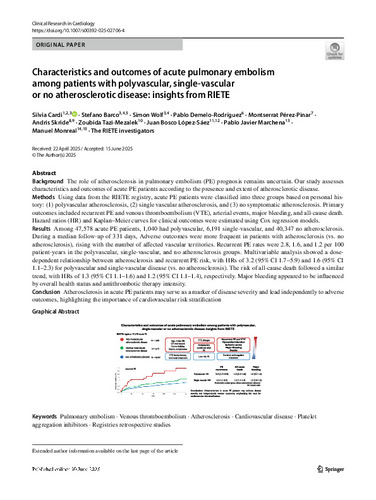
Results Among 47,578 acute PE patients, 1,040 had polyvascular, 6,191 single-vascular, and 40,347 no atherosclerosis.
During a median follow-up of 331 days, Adverse outcomes were more frequent in patients with atherosclerosis (vs. no
atherosclerosis), rising with the number of affected vascular territories. Recurrent PE rates were 2.8, 1.6, and 1.2 per 100
patient-years in the polyvascular, single-vascular, and no atherosclerosis groups. Multivariable analysis showed a dosedependent relationship between atherosclerosis and recurrent PE risk, with HRs of 3.2 (95% CI 1.7–5.9) and 1.6 (95% CI
1.1–2.3) for polyvascular and single-vascular disease (vs. no atherosclerosis). The risk of all-cause death followed a similar
trend, with HRs of 1.3 (95% CI 1.1–1.6) and 1.2 (95% CI 1.1–1.4), respectively. Major bleeding appeared to be influenced
by overall health status and antithrombotic therapy intensity.
Conclusion Atherosclerosis in acute PE patients may serve as a marker of disease severity and lead independently to adverse
outcomes, highlighting the importance of cardiovascular risk stratification
Collections
- Artículos Científicos [11595]
- Articulos Científicos Medicina [263]

This work is under a Creative Commons License Attribution-NonCommercial-NoDerivatives 4.0 Internacional