Iterative deep learning for cetacean whistle detection in the Strait of Gibraltar
Identificadores
URI: http://hdl.handle.net/10498/38514
DOI: 10.1016/j.engappai.2026.113756
ISSN: 0952-1976
Statistics
Metrics and citations
Export





Metadata
Show full item record
Date
2026-03Source
Engineering Applications of Artificial Intelligence -2026, vol. 167 (parte 1), 113756Abstract
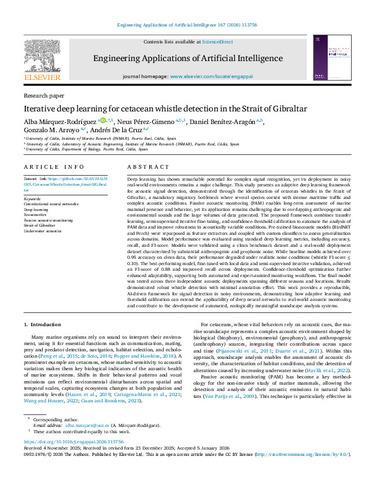
Deep learning has shown remarkable potential for complex signal recognition, yet its deployment in noisy real-world environments remains a major challenge. This study presents an adaptive deep learning framework for acoustic signal detection, demonstrated through the identification of cetacean whistles in the Strait of Gibraltar, a mandatory migratory bottleneck where several species coexist with intense maritime traffic and complex acoustic conditions. Passive acoustic monitoring (PAM) enables long-term assessment of marine mammal presence and behavior, yet its application remains challenging due to overlapping anthropogenic and environmental sounds and the large volumes of data generated. The proposed framework combines transfer learning, semi-supervised iterative fine-tuning, and confidence-threshold calibration to automate the analysis of PAM data and improve robustness in acoustically variable conditions. Pre-trained bioacoustic models (BirdNET and Perch) were repurposed as feature extractors and coupled with custom classifiers to assess generalization across domains. Model performance was evaluated using standard deep learning metrics, including accuracy, recall, and F1-score. Models were validated using a clean benchmark dataset and a real-world deployment dataset characterized by substantial anthropogenic and geophonic noise. While baseline models achieved over 0.95 accuracy on clean data, their performance degraded under realistic noise conditions (whistle F1-score
0.10). The best-performing model, fine-tuned with local data and semi-supervised iterative validation, achieved an F1-score of 0.88 and improved recall across deployments. Confidence-threshold optimization further enhanced adaptability, supporting both automated and expert-assisted monitoring workflows. The final model was tested across three independent acoustic deployments spanning different seasons and locations. Results demonstrated robust whistle detection with minimal annotation effort. This work provides a reproducible, AI-driven framework for signal detection in noisy environments, demonstrating how adaptive learning and threshold calibration can extend the applicability of deep neural networks to real-world acoustic monitoring and contribute to the development of automated, ecologically meaningful soundscape analysis systems.
Collections
- Artículos Científicos [11595]
- Artículos Científicos INMAR [1016]

This work is under a Creative Commons License Attribution-NonCommercial-NoDerivatives 4.0 Internacional