Impacts of El Niño on the sediment balance of a transgressive dune-beach system
Identificadores
URI: http://hdl.handle.net/10498/38606
DOI: 10.1016/J.SCITOTENV.2025.180348
ISSN: 1879-1026
ISSN: 0048-9697
Statistics
Metrics and citations
Export





Metadata
Show full item record
Date
2025-08-28Source
Science of the Total Environment, Vol. 999, 2025Abstract
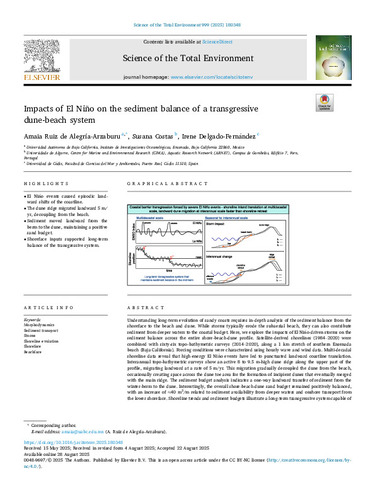
Understanding long-term evolution of sandy coasts requires in-depth analysis of the sediment balance from the
shoreface to the beach and dune. While storms typically erode the subaerial beach, they can also contribute
sediment from deeper waters to the coastal budget. Here, we explore the impacts of El Nino-driven ˜ storms on the
sediment balance across the entire shore-beach-dune profile. Satellite-derived shorelines (1984–2020) were
combined with sixty-six topo-bathymetric surveys (2014–2020), along a 1 km stretch of southern Ensenada
beach (Baja California). Forcing conditions were characterized using hourly wave and wind data. Multi-decadal
shoreline data reveal that high-energy El Nino ˜ events have led to punctuated landward coastline translation.
Interannual topo-bathymetric surveys show an active 8 to 9.5 m-high dune ridge along the upper part of the
profile, migrating landward at a rate of 5 m/yr. This migration gradually decoupled the dune from the beach,
occasionally creating space across the dune toe area for the formation of incipient dunes that eventually merged
with the main ridge. The sediment budget analysis indicates a one-way landward transfer of sediment from the
winter-berm to the dune. Interestingly, the overall shore-beach-dune sand budget remained positively balanced,
with an increase of ≈40 m3
/m related to sediment availability from deeper waters and onshore transport from
the lower shoreface. Shoreline trends and sediment budgets illustrate a long-term transgressive system capable of maintaining sedimentary balance in the mid-term. Increased storm activity and sea-level rise are expected to
accelerate beach-dune transgression, which could retain sediment balance if offshore inputs persist.
Collections
- Artículos Científicos [11595]
- Articulos Científicos CC. Tierra [261]
- Artículos Científicos INMAR [1016]

This work is under a Creative Commons License Attribution-NonCommercial-NoDerivatives 4.0 Internacional