Effect of Two Different Pretreatments of Brewers Spent Grain Used as Feed Ingredient on Nutritional, Immunological, and Metabolical Parameters in Gilthead Seabream (Sparus aurata)
Statistics
Metrics and citations
Export





Metadata
Show full item record
Date
2025-05-22Source
Biology, Vol. 14, Núm. 6, 2025Abstract
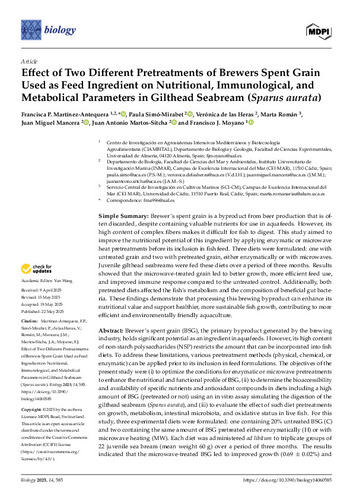
Brewer’s spent grain (BSG), the primary byproduct generated by the brewing industry, holds significant potential as an ingredient in aquafeeds. However, its high content of non-starch polysaccharides (NSP) restricts the amount that can be incorporated into fish diets. To address these limitations, various pretreatment methods (physical, chemical, or enzymatic) can be applied prior to its inclusion in feed formulations. The objectives of the present study were (i) to optimize the conditions for enzymatic or microwave pretreatments to enhance the nutritional and functional profile of BSG, (ii) to determine the bioaccessibility and availability of specific nutrients and antioxidant compounds in diets including a high amount of BSG (pretreated or not) using an in vitro assay simulating the digestion of the gilthead seabream (Sparus aurata), and (iii) to evaluate the effect of such diet pretreatments on growth, metabolism, intestinal microbiota, and oxidative status in live fish. For this study, three experimental diets were formulated: one containing 20% untreated BSG (C) and two containing the same amount of BSG pretreated either enzymatically (H) or with microwave heating (MW). Each diet was administered ad libitum to triplicate groups of 22 juvenile sea bream (mean weight 60 g) over a period of three months. The results indicated that the microwave-treated BSG led to improved growth (0.69 ± 0.02%) and feed efficiency (0.80 ± 0.02 weight gain/total feed intake) and enhanced immune status (alkaline phosphatase activity = 11,811.68 ± 3426.92 U/mg SP), compared to the control diet (SGR = 0.59 ± 0.06%; FE: 0.68 ± 0.03 weight gain/total feed intake; alkaline phosphatase activity = 8590.29 ± 3663.44 U/mg SP). Moreover, fish fed on both pretreated BSG diets exhibited significant differences in metabolic parameters and functional profile of their intestinal microbiota when compared to the control group. Consequently, the findings suggest that the pretreatment of BSG, whether by enzymatic or microwave methods, results in notable differences in its nutritional value and the bioavailability of functional components, which, in turn, have a substantial impact on the growth and metabolism of gilthead seabream.
Collections
- Artículos Científicos [11777]
- Articulos Científicos Biología [857]
- Artículos Científicos INMAR [1027]

This work is under a Creative Commons License Attribution-NonCommercial-NoDerivatives 4.0 Internacional