Tempus: An Evolutionary Mutation Testing System on Event-Based Systems With Profile-Based Individual Generation
Identificadores
URI: http://hdl.handle.net/10498/38729
DOI: 10.1002/STVR.70005
ISSN: 1099-1689
ISSN: 0960-0833
Ficheros
Estadísticas
Métricas y Citas
Exportar a





Metadatos
Mostrar el registro completo del ítem
Fecha
2025Fuente
Software Testing Verification and Reliability - 2025, Vol. 35 n. 5, artículo n. e70005Resumen
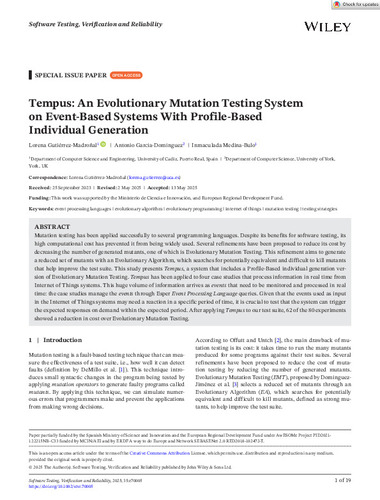
Mutation testing has been applied successfully to several programming languages. Despite its benefits for software testing, its high computational cost has prevented it from being widely used. Several refinements have been proposed to reduce its cost by decreasing the number of generated mutants, one of which is Evolutionary Mutation Testing. This refinement aims to generate a reduced set of mutants with an Evolutionary Algorithm, which searches for potentially equivalent and difficult to kill mutants that help improve the test suite. This study presents Tempus, a system that includes a Profile-Based individual generation version of Evolutionary Mutation Testing. Tempus has been applied to four case studies that process information in real time from Internet of Things systems. This huge volume of information arrives as events that need to be monitored and processed in real time: the case studies manage the events through Esper Event Processing Language queries. Given that the events used as input in the Internet of Things systems may need a reaction in a specific period of time, it is crucial to test that the system can trigger the expected responses on demand within the expected period. After applying Tempus to our test suite, 62 of the 80 experiments showed a reduction in cost over Evolutionary Mutation Testing.
Colecciones
- Artículos Científicos [11777]
- Articulos Científicos Ing. Inf. [306]

Esta obra está bajo una Licencia Creative Commons Atribución 4.0 Internacional