Assessment of microplastic retention efficiency using pilot-scale filtration systems applied to drinking water
Identificadores
URI: http://hdl.handle.net/10498/39068
DOI: 10.1016/J.JHAZMAT.2025.140130
ISSN: 1873-3336
ISSN: 0304-3894
Statistics
Metrics and citations
Export





Metadata
Show full item record
Date
2025-11Source
Journal of Hazardous Materials - 2025, Vol. 499, 140130Abstract
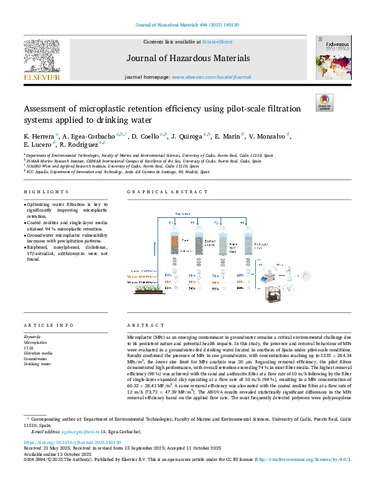
Microplastic (MPs) as an emerging contaminant in groundwater remains a critical environmental challenge due to its persistent nature and potential health impacts. In this study, the presence and removal behaviour of MPs were evaluated in a groundwater-fed drinking water located in southern of Spain under pilot-scale conditions. Results confirmed the presence of MPs in raw groundwater, with concentrations reaching up to 1235 ± 284.34 MPs/m3, the lower size limit for MPs analysis was 20 µm. Regarding removal efficiency, the pilot filters demonstrated high performance, with overall retention exceeding 74 % in most filter media. The highest removal efficiency (98 %) was achieved with the sand and anthracite filter at a flow rate of 10 m/h following by the filter of single-layer expanded clay operating at a flow rate of 10 m/h (94 %), resulting in a MPs concentration of 60.32 ± 28.43 MP/m3. A same removal efficiency was also noted with the coated zeolites filter at a flow rate of 12 m/h (73.72 ± 47.39 MP/m3). The ANOVA results revealed statistically significant differences in the MPs removal efficiency based on the applied flow rate. The most frequently detected polymers were polypropylene (PP) and polyethylene (PE). This study highlights the potential of filtration media systems in DWTPs to effectively remove MPs from groundwater.
Collections
- Artículos Científicos [11777]
- Artículos Científicos INMAR [1027]
- Artículos Científicos IVAGRO [721]
- Articulos Científicos Tec. Med. Amb. [214]

This work is under a Creative Commons License Attribution 4.0 Internacional