Long-term performance and operational factors of a pilot-scale bioscrubber for landfill biogas desulfurization
Identificadores
URI: http://hdl.handle.net/10498/39417
DOI: 10.1016/J.JCLEPRO.2025.147100
ISSN: 0959-6526
Statistics
Metrics and citations
Export





Metadata
Show full item record
Date
2025-12Source
Journal of Cleaner Production - 2025, Vol. 534, 147100Abstract
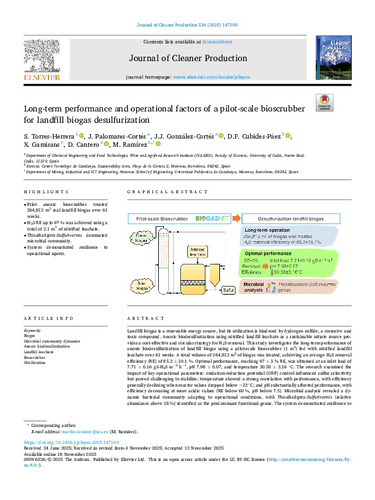
Landfill biogas is a renewable energy source, but its utilization is hindered by hydrogen sulfide, a corrosive and toxic compound. Anoxic biodesulfurization using nitrified landfill leachate as a sustainable nitrate source provides a cost-effective and circular strategy for H2S removal. This study investigates the long-term performance of anoxic biodesulfurization of landfill biogas using a pilot-scale bioscrubber (1 m3) fed with nitrified landfill leachate over 61 weeks. A total volume of 264,812 m3 of biogas was treated, achieving an average H2S removal efficiency (RE) of 85.2 ± 10.1 %. Optimal performance, reaching 97 ± 3 % RE, was obtained at an inlet load of 7.71 ± 0.16 gS-H2S m−3 h−1, pH 7.98 ± 0.07, and temperature 30.58 ± 3.16 °C. The research examined the impact of key operational parameters: oxidation-reduction potential (ORP) control influenced sulfur selectivity but proved challenging to stabilize; temperature showed a strong correlation with performance, with efficiency generally declining when reactor values dropped below ∼22 °C; and pH substantially affected performance, with efficiency decreasing at more acidic values (RE below 60 %, pH below 7.5). Microbial analysis revealed a dynamic bacterial community adapting to operational conditions, with Thioalkalispira-Sulfurivermis (relative abundance above 18 %) identified as the predominant functional genus. The system demonstrated resilience to operational disturbances like recirculation pump failure and fluctuations in biogas flow rate. This study provides valuable insights into the practical application of anoxic bioscrubbers for landfill biogas biodesulfurization, highlighting controlling factors and offering a foundation for enhancing the efficiency and sustainability of biogas purification technologies under real-world constraints.
Collections
- Artículos Científicos [11777]
- Articulos Científicos Ing. Quim. [308]

This work is under a Creative Commons License Atribución-NoComercial 4.0 Internacional