Prevalencia y factores asociados a la depresión en la población española: datos de la Encuesta Europea de Salud
Identificadores
URI: http://hdl.handle.net/10498/40514
DOI: 10.1016/J.APRIM.2026.103477
ISSN: 1578-1275
ISSN: 0212-6567
Statistics
Metrics and citations
Export





Metadata
Show full item recordAlternative title
Prevalence and factors associated with depression in the Spanish population: data from the European Health Survey

Date
2026-06-09Source
Atencion Primaria - 2026, Vol. 58 n. 9, 103477Abstract
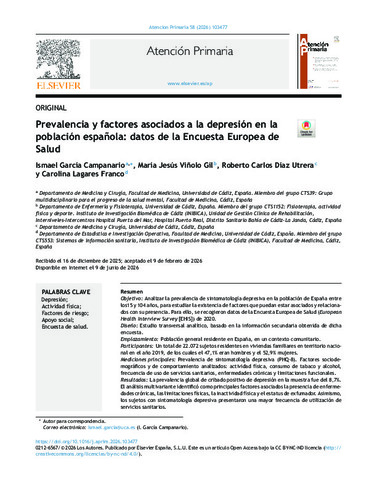
Objective To analyze the prevalence of depressive symptomatology in the population between 15 and 104 years of age in Spain to study whether there are factors that may be associated with and related to its presence. To this end, data from the 2020 European Health Interview Survey (EHIS) were collected. Design Analytical cross-sectional study, based on secondary information obtained from this survey. Setting General population residing in Spain, in a community context. Participants A total of 22,072 subjects residing in family homes in the national territory in 2019, of which 47.1% were men and 52.9% women. Main measurements Prevalence of depressive symptomatology (PHQ-8). Sociodemographic and behavioural factors analysed: physical activity, tobacco and alcohol consumption, frequency of use of health services, chronic diseases and functional limitations. Results The overall prevalence of positive depression screening in the sample was 8.7%. The multivariate analysis identified the presence of chronic diseases, physical limitations, physical inactivity, and former smoking status as the main associated factors. Likewise, subjects with depressive symptomatology had a higher frequency of use of health services. Conclusion There are several modifiable behavioural factors associated with depressive symptomatology. The promotion of physical activity and the comprehensive approach to chronicity and functional capacity could be key strategies to improve the state of mental health in the population. Objetivo: Analizar la prevalencia de sintomatología depresiva en la población de Espana˜ entre
los15 y 104 anos, ˜ para estudiar la existencia de factores que puedan estar asociados y relacionados con su presencia. Para ello, se recogieron datos de la Encuesta Europea de Salud (European
Health Interview Survey [EHIS]) de 2020.
Diseno: ˜ Estudio transversal analítico, basado en la información secundaria obtenida de dicha
encuesta.
Emplazamiento: Población general residente en Espana, ˜ en un contexto comunitario.
Participantes: Un total de 22.072 sujetos residentes en viviendas familiares en territorio nacional en el ano˜ 2019, de los cuales el 47,1% eran hombres y el 52,9% mujeres.
Mediciones principales: Prevalencia de sintomatología depresiva (PHQ-8). Factores sociodemográficos y de comportamiento analizados: actividad física, consumo de tabaco y alcohol,
frecuencia de uso de servicios sanitarios, enfermedades crónicas y limitaciones funcionales.
Resultados: La prevalencia global de cribado positivo de depresión en la muestra fue del 8,7%.
El análisis multivariante identificó como principales factores asociados la presencia de enfermedades crónicas, las limitaciones físicas, la inactividad física y el estatus de exfumador. Asimismo,
los sujetos con sintomatología depresiva presentaron una mayor frecuencia de utilización de
servicios sanitarios.
Collections
- Artículos Científicos [11954]

This work is under a Creative Commons License Attribution-NonCommercial-NoDerivatives 4.0 Internacional