Prognostic impact of glim-defined malnutrition and phase angle in patients with digestive tumors
Identificadores
URI: http://hdl.handle.net/10498/40776
DOI: 10.3389/FNUT.2026.1836804
ISSN: 2296-861X
Statistics
Metrics and citations
Export





Metadata
Show full item record
Date
2026-05-13Source
Frontiers in Nutrition - 2026, Vol. 13, 1836804Abstract
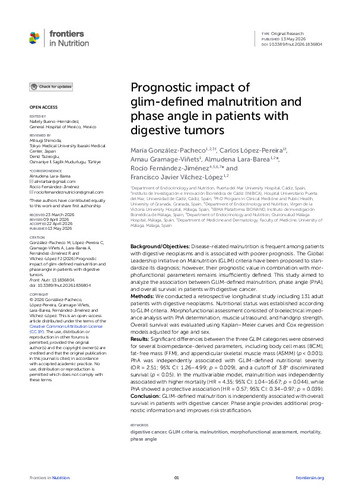
Background/Objectives: Disease-related malnutrition is frequent among patients with digestive neoplasms and is associated with poorer prognosis. The Global Leadership Initiative on Malnutrition (GLIM) criteria have been proposed to standardize its diagnosis; however, their prognostic value in combination with morphofunctional parameters remains insufficiently defined. This study aimed to analyze the association between GLIM-defined malnutrition, phase angle (PhA), and overall survival in patients with digestive cancer.Methods: We conducted a retrospective longitudinal study including 131 adult patients with digestive neoplasms. Nutritional status was established according to GLIM criteria. Morphofunctional assessment consisted of bioelectrical impedance analysis with PhA determination, muscle ultrasound, and handgrip strength. Overall survival was evaluated using Kaplan–Meier curves and Cox regression models adjusted for age and sex.Results: Significant differences between the three GLIM categories were observed for several bioimpedance-derived parameters, including body cell mass (BCM), fat-free mass (FFM), and appendicular skeletal muscle mass (ASMM) (p < 0.001). PhA was independently associated with GLIM-defined nutritional severity (OR = 2.51; 95% CI: 1.26–4.99; p = 0.009), and a cutoff of 3.8° discriminated survival (p < 0.05). In the multivariable model, malnutrition was independently associated with higher mortality (HR = 4.35; 95% CI: 1.04–16.67; p = 0.044), while PhA showed a protective association (HR = 0.57; 95% CI: 0.34–0.97; p = 0.039).Conclusion: GLIM-defined malnutrition is independently associated with overall survival in patients with digestive cancer. Phase angle provides additional prognostic information and improves risk stratification.
Collections
- Artículos Científicos [12077]

This work is under a Creative Commons License http://creativecommons.org/licenses/by/4.0/