Optimized HSSE-GC-MS and machine learning for forensic gender classification of human scent from clothing
Identificadores
URI: http://hdl.handle.net/10498/39424
DOI: 10.1016/j.aca.2026.345337
ISSN: 1873-4324
Ficheros
Estadísticas
Métricas y Citas
Exportar a


Metadatos
Mostrar el registro completo del ítem
Fecha
2026-03Fuente
Analytica Chimica Acta - 2026, 1400, 345337Resumen
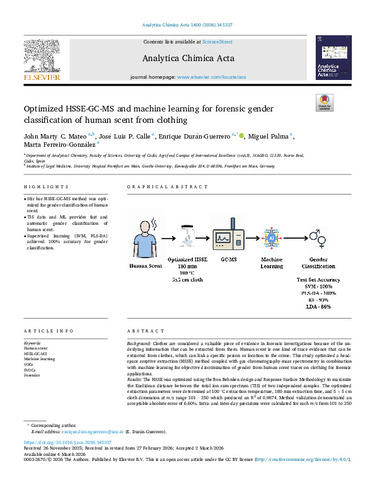
Clothes are considered a valuable piece of evidence in forensic investigations because of the underlying information that can be extracted from them. Human scent is one kind of trace evidence that can be extracted from clothes, which can link a specific person or location to the crime. This study optimized a headspace sorptive extraction (HSSE) method coupled with gas chromatography-mass spectrometry in combination with machine learning for objective discrimination of gender from human scent traces on clothing for forensic applications.
The HSSE was optimized using the Box-Behnken design and Response Surface Methodology to maximize the Euclidean distance between the total ion sum spectrum (TIS) of two independent samples. The optimized extraction parameters were determined at 100 °C extraction temperature, 180 min extraction time, and 5 × 5 cm cloth dimension at m/z range 101 – 250 which produced an R2 of 0.9874. Method validation demonstrated an acceptable absolute error of 6.60%. Intra- and inter-day precisions were calculated for each m/z from 101 to 250 to remove outliers from the dataset for the multivariate analysis. Using the optimized extraction method, 62 samples were analyzed and the pre-processed TIS from the samples were subjected to various supervised machine learning algorithms. Support vector machine (SVM) and partial least squares-discriminant analysis (PLS-DA) models achieved perfect 100% accuracy for gender classification in both training and test sets. Random forest (RF) and linear discriminant analysis (LDA) also showed high test set accuracies of 93% and 86%, respectively.
This integrated approach, combining optimized stir bar HSSE-GC-MS with different machine learning algorithms using the TIS untargeted approach, provides a fast and automatic gender classification from human scent traces on clothes that can be used as a rapid screening technique in forensic investigations to narrow down suspect or victim profiles.
Colecciones
- Artículos Científicos [11620]

Esta obra está bajo una Licencia Creative Commons Attribution-NonCommercial-NoDerivatives 4.0 Internacional