Figuraciones del exilio entre la tradición clásica y el Carnaval gaditano: Ovidio y Antonio Martínez Ares
Identificadores
URI: http://hdl.handle.net/10498/40737
DOI: https://doi.org/10.24197/e8ms0y82
ISSN: 2530-6480
Files
Statistics
Metrics and citations
Export


Metadata
Show full item recordAlternative title
Representations of exile between classical tradition and the Cadiz Carnival: Ovid and Antonio Martínez Ares
Date
2025-12-19Source
Minerva. Revista de Filología Clásica - 2025, n.38 pp. 169-187Abstract
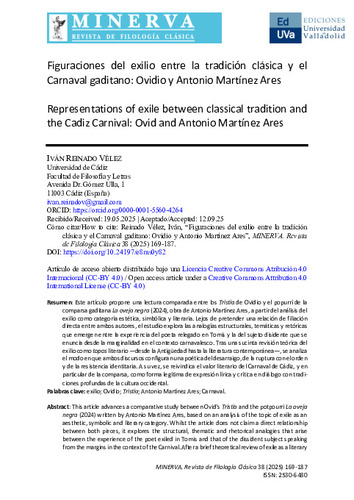
Este artículo propone una lectura comparada entre los "Tristia" de Ovidio y el popurrí de la
comparsa gaditana "La oveja negra" (2024), obra de Antonio Martínez Ares, a partir del análisis del
exilio como categoría estética, simbólica y literaria. Lejos de pretender una relación de filiación
directa entre ambos autores, el estudio explora las analogías estructurales, temáticas y retóricas
que emergen entre la experiencia del poeta relegado en Tomis y la del sujeto disidente que se
enuncia desde la marginalidad en el contexto carnavalesco. Tras una sucinta revisión teórica del
exilio como toposliterario —desde la Antigüedad hasta la literatura contemporánea—, se analiza
el modo en que ambos discursos configuran una poética del desarraigo, de la ruptura con el orden
y de la resistencia identitaria. A su vez, se reivindica el valor literario del Carnaval de Cádiz, y en
particular de la comparsa, como forma legítima de expresión lírica y crítica en diálogo con tradiciones profundas de la cultura occidental. This article advances a comparative study between Ovid's "Tristia" and the potpourri "La oveja
negra" (2024) written by Antonio Martínez Ares, based on an analysis of the topic of exile as an
aesthetic, symbolic and literary category. Whilst the article does not claim a direct relationship
between both pieces, it explores the structural, thematic and rhetorical analogies that arise
between the experience of the poet exiled in Tomis and that of the dissident subject speaking
from the margins in the context of the Carnival. After a brief theoretical review of exile as a literary motif —from antiquity to contemporary literature— the study analyses how both texts shape
a poetics of uprootedness, a break- away from the order and an identity resistance. At the same
time, it supports the literary value of the Cádiz Carnival, and in particular of the comparsa, as a
legitimate form of lyrical and critical expression in line with traditions deep-rooted in Western
culture.
Collections
- Artículos Científicos [12122]
- Articulos Científicos Fil. Clas. [259]

This work is under a Creative Commons License http://creativecommons.org/licenses/by/4.0/