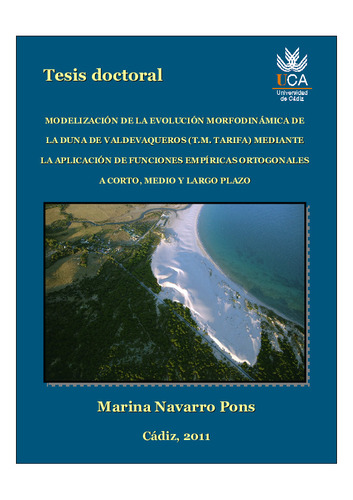
Modelización de la evolución morfodinámica de la duna de Valdevaqueros (t.m. Tarifa) mediante la aplicación de funciones empíricas ortogonales a corto, medio y largo plazo
Identificadores
Statistics
Export





Metadata
Show full item recordDate
2011-10-27Advisor
Muñoz Pérez, Juan José
Abstract
Extreme wind conditions generated near the Strait of Gibraltar (SW Spain) have given rise to the transgressive Valdevaqueros dunefield. The dune advance has resulted in gradual invasion of the adjacent road and ecosystem. Despite restoration and control activities performed within the last decades, strong east winds have favoured dune destabilisation. The current work focuses on analyzing the dune profile evolution in the long term (years), medium term (months), short term (days) and very short term (hours).
Topographic data, which were collected with a total station and a differential GPS from 1995 to 2009, were interpreted from reconstructed Empirical Orthogonal Functions (EOF). This method provides an objective way to identify the mean dune profile and therefore, to recognize morphodynamic dune changes and tendencies.
Wind, humidity, rain and temperature effects on the dune behaviour were analysed from the Tarifa meteorological station. Furthermore, a sand trap was placed on three different dune profile areas during 30 min, obtaining that the sand transport at the crest was twice the amount of the sand collected at the windward and near six times greater than the sand measured at the dune foot.
Sand transport rates of 140 m3 m-1 year-1, 25.5–36.5 m3 m−1 month−1, 22.52 m3 m−1 day−1 and 0.93 m3 m−1 h−1 were measured for the long-term, medium-term, short-term and very short-term periods, respectively. During an eleven-year period, the average migration rate was found to be of 17.5 m year-1, although the very short term monitoring under a severe easterly sandstorm demonstrated that the dune brink was able to experience an advance of 1.75 m in only 24 h. These values were compared with the theoretical sand transport rate for Valdevaqueros dune, based on the classic Bagnold’s equation as well as other more recent formulae, to obtain a ratio between the real and the theoretical rates for each study period. These results together with the sand drift potential following the Fryberger’s method (up to 10,000 vector units) demonstrate that Valdevaqueros is a dunefield with one of the highest sand transport capacities in Europe.
Collections
- Tesis [767]
- Tesis Fis. Ap. [22]