• español
    • English
  • Login
  • español 
    • español
    • English

UniversidaddeCádiz

Área de Biblioteca, Archivo y Publicaciones
Comunidades y colecciones
Ver ítem 
  •   RODIN Principal
  • Institutos de Investigación
  • Instituto de Investigaciones Marinas INMAR
  • Artículos Científicos INMAR
  • Ver ítem
  •   RODIN Principal
  • Institutos de Investigación
  • Instituto de Investigaciones Marinas INMAR
  • Artículos Científicos INMAR
  • Ver ítem
JavaScript is disabled for your browser. Some features of this site may not work without it.

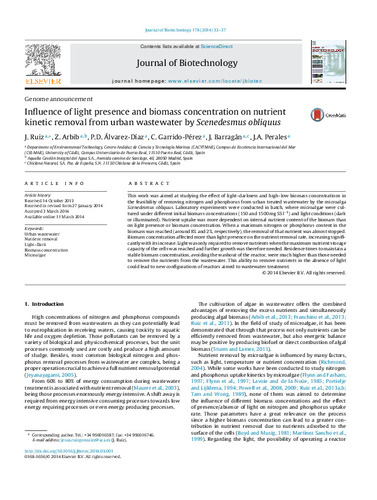
Influence of light presence and biomass concentration on nutrient kinetic removal from urban wastewater by Scenedesmus obliquus.
Thumbnail
Identificadores

URI: http://hdl.handle.net/10498/19695

DOI: 10.1016/j.jbiotec.2014.03.001

URL: doi.org/10.1016/j.jbiotec.2014.03.001

Ficheros
2014 Journal of Biotechnology.pdf (305.8Kb)
Estadísticas
Ver estadísticas
Métricas y Citas
 
Compartir
Exportar a
Exportar a MendeleyRefworksEndNoteBibTexRIS
Metadatos
Mostrar el registro completo del ítem
Autor/es
Ruiz González, JesúsAutoridad UCA; Arbib, Zouhayr; Álvarez Díaz, Pablo David; Garrido Pérez, CarmenAutoridad UCA; Barragán Sánchez, JesúsAutoridad UCA; Perales Vargas-Machuca, José AntonioAutoridad UCA
Fecha
2014
Departamento/s
Tecnologías del Medio Ambiente
Fuente
Journal of Biotechnology. 178, pp. 32 - 37. 2014
Resumen
This work was aimed at studying the effect of light–darkness and high–low biomass concentrations in the feasibility of removing nitrogen and phosphorus from urban treated wastewater by the microalga Scenedesmus obliquus. Laboratory experiments were conducted in batch, where microalgae were cultured under different initial biomass concentrations (150 and 1500 mg SS l−1) and light conditions (dark or illuminated). Nutrient uptake was more dependent on internal nutrient content of the biomass than on light presence or biomass concentration. When a maximum nitrogen or phosphorus content in the biomass was reached (around 8% and 2%, respectively), the removal of that nutrient was almost stopped. Biomass concentration affected more than light presence on the nutrient removal rate, increasing significantly with its increase. Light was only required to remove nutrients when the maximum nutrient storage capacity of the cells was reached and further growth was therefore needed. Residence times to maintain a stable biomass concentration, avoiding the washout of the reactor, were much higher than those needed to remove the nutrients from the wastewater. This ability to remove nutrients in the absence of light could lead to new configurations of reactors aimed to wastewater treatment.
Materias
Urban wastewater; Nutrient removal; Light–Dark; Biomass concentration; Microalgae
Colecciones
  • Artículos Científicos [12089]
  • Artículos Científicos INMAR [1050]
  • Articulos Científicos Tec. Med. Amb. [217]

Listar

Todo RODINComunidades y ColeccionesPor fecha de publicaciónAutoresTítulosMateriasEsta colecciónPor fecha de publicaciónAutoresTítulosMaterias

Mi cuenta

AccederRegistro

Estadísticas

Ver Estadísticas de uso

Información adicional

Acerca de...Deposita en RODINPolíticasNormativasDerechos de autorEnlaces de interésEstadísticasNovedadesPreguntas frecuentes

RODIN está accesible a través de

OpenAIREOAIsterRecolectaHispanaEuropeanaBaseDARTOATDGoogle Académico

Enlaces de interés

Sherpa/RomeoDulcineaROAROpenDOARCreative CommonsORCID

RODIN está gestionado por el Área de Biblioteca, Archivo y Publicaciones de la Universidad de Cádiz

ContactoSugerenciasAtención al Usuario

