Dietary Tryptophan Induces Opposite Health-Related Responses in the Senegalese Sole (Solea senegalensis) Reared at Low or High Stocking Densities With Implications in Disease Resistance
Ficheros
Estadísticas
Métricas y Citas
Exportar a





Metadatos
Mostrar el registro completo del ítem
Fecha
2019-05Fuente
FRONTIERS IN PHYSIOLOGY Volumen: 10 Número de artículo: 508Resumen
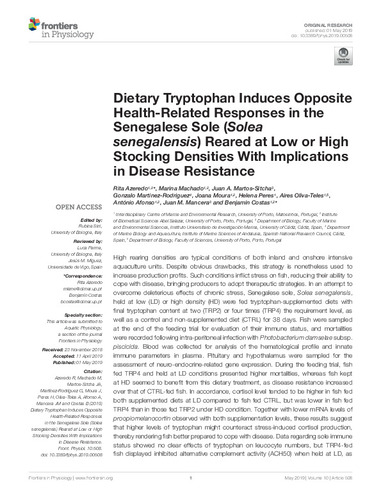
High rearing densities are typical conditions of both inland and onshore intensive
aquaculture units. Despite obvious drawbacks, this strategy is nonetheless used to
increase production profits. Such conditions inflict stress on fish, reducing their ability to
cope with disease, bringing producers to adopt therapeutic strategies. In an attempt to
overcome deleterious effects of chronic stress, Senegalese sole, Solea senegalensis,
held at low (LD) or high density (HD) were fed tryptophan-supplemented diets with
final tryptophan content at two (TRP2) or four times (TRP4) the requirement level, as
well as a control and non-supplemented diet (CTRL) for 38 days. Fish were sampled
at the end of the feeding trial for evaluation of their immune status, and mortalities
were recorded following intra-peritoneal infection with Photobacterium damselae subsp.
piscicida. Blood was collected for analysis of the hematological profile and innate
immune parameters in plasma. Pituitary and hypothalamus were sampled for the
assessment of neuro-endocrine-related gene expression. During the feeding trial, fish
fed TRP4 and held at LD conditions presented higher mortalities, whereas fish kept
at HD seemed to benefit from this dietary treatment, as disease resistance increased
over that of CTRL-fed fish. In accordance, cortisol level tended to be higher in fish fed
both supplemented diets at LD compared to fish fed CTRL, but was lower in fish fed
TRP4 than in those fed TRP2 under HD condition. Together with lower mRNA levels of
proopiomelanocortin observed with both supplementation levels, these results suggest
that higher levels of tryptophan might counteract stress-induced cortisol production,
thereby rendering fish better prepared to cope with disease. Data regarding sole immune
status showed no clear effects of tryptophan on leucocyte numbers, but TRP4-fed
fish displayed inhibited alternative complement activity (ACH50) when held at LD, as
opposed to their HD counterparts whose ACH50 was higher than that of CTRLfed
fish. In conclusion, while dietary tryptophan supplementation might have harmful
effects in control fish, it might prove to be a promising strategy to overcome chronic
stress-induced disease susceptibility in farmed Senegalese sole.
Colecciones
- Artículos Científicos [12059]
- Articulos Científicos Biología [871]
- Artículos Científicos INMAR [1048]

Esta obra está bajo una Licencia Creative Commons Attribution-NonCommercial-NoDerivatives 4.0 Internacional