Comparative study of traditional active sludge systems and microalgae biotechnology for emerging pollutants removal
Identificadores
Files
Statistics
Export





Metadata
Show full item recordAlternative title
Estudio comparativo de sistemas tradicionales de lodos activos y biotecnología de microalgas para la eliminación de contaminantes emergentes

Date
2019-07Abstract
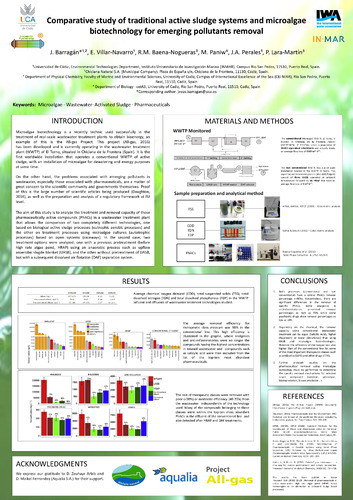
Microalgae biotechnology is a recently technic used successfully in the treatment of real-scale wastewater treatment plants to obtain bioenergy, an example of this is the All-gas Project. This project (All-gas, 2016) has been developed and is currently operating in the wastewater treatment plant (WWTP) of El Torno, situated in Chiclana de la Frontera (Spain). It is the first worldwide installation that operates a conventional WWTP of active sludge, with an installation of microalgae for dewatering and energy purposes at same time.
On the other hand, the problems associated with emerging pollutants in wastewater, especially those associated with pharmaceuticals, are a matter of great concern to the scientific community and governments themselves. Proof of this is the large number of scientific articles being produced (Daughton, 2016), as well as the preparation and analysis of a regulatory framework at EU level.
The aim of this study is to analyze the treatment and removal capacity of these pharmaceutically active compounds (PhACs) in a wastewater treatment plant that allows the comparison of two completely different technologies, one based on biological active sludge processes (eutrophic aerobic processes) and the other on treatment processes using microalgae cultures (autotrophic processes) based on open systems (raceways). In the second case, two treatment options were analyzed; one with a previous pretreatment (before high rate algae pond, HRAP) using an anaerobic process such as upflow anaerobic slugde blanket (UASB), and the other without pretreatment of UASB, but with a subsequent dissolved air flotation (DAF) separation system.
Collections

This work is under a Creative Commons License Attribution-NonCommercial-NoDerivatives 4.0 Internacional