Main Variables Affecting a Chemical-Enzymatic Method to Obtain Protein and Amino Acids from Resistant Microalgae
Ficheros
Estadísticas
Métricas y Citas
Exportar a





Metadatos
Mostrar el registro completo del ítem
Fecha
2019Fuente
Journal of Chemistry Volume 2019, Article ID 1390463Resumen
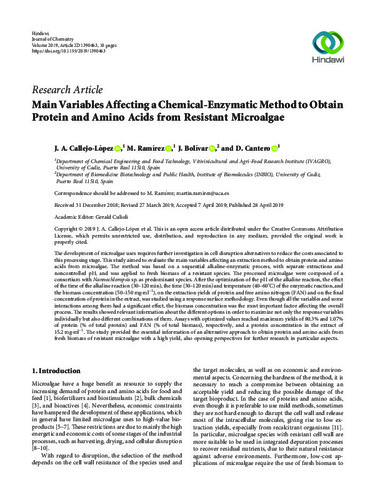
he development of microalgae uses requires further investigation in cell disruption alternatives to reduce the costs associated to this processing stage. This study aimed to evaluate the main variables affecting an extraction method to obtain protein and amino acids from microalgae. The method was based on a sequential alkaline-enzymatic process, with separate extractions and noncontrolled pH, and was applied to fresh biomass of a resistant species. The processed microalgae were composed of a consortium with Nannochloropsis sp. as predominant species. After the optimization of the pH of the alkaline reaction, the effect of the time of the alkaline reaction (30-120min), the time (30-120min) and temperature (40-60 degrees C) of the enzymatic reaction, and the biomass concentration (50-150mgml(-1)), on the extraction yields of protein and free amino nitrogen (FAN) and on the final concentration of protein in the extract, was studied using a response surface methodology. Even though all the variables and some interactions among them had a significant effect, the biomass concentration was the most important factor affecting the overall process. The results showed relevant information about the different options in order to maximize not only the response variables individually but also different combinations of them. Assays with optimized values reached maximum yields of 80.3% and 1.07% of protein (% of total protein) and FAN (% of total biomass), respectively, and a protein concentration in the extract of 15.2mgml(-1). The study provided the essential information of an alternative approach to obtain protein and amino acids from fresh biomass of resistant microalgae with a high yield, also opening perspectives for further research in particular aspects.
Colecciones
- Artículos Científicos [11777]
- Articulos Científicos Biomedicina [577]
- Artículos Científicos INBIO [417]
- Articulos Científicos Ing. Quim. [308]
- Artículos Científicos IVAGRO [721]

Esta obra está bajo una Licencia Creative Commons Atribución 4.0 Internacional