La participación de la mujer tunecina en la construcción de la paz: participación relevante en la transición democrática
Identificadores
URI: http://hdl.handle.net/10498/21940
DOI: 10.25267/Rev_estud_socioeducativos.2018.i6.09
ISSN: 2341-3255
Ficheros
Estadísticas
Métricas y Citas
Exportar a





Metadatos
Mostrar el registro completo del ítemTítulo alternativo
The participation of Tunisian women in the construction of peace: relevant participation in the democratic transition.
Fecha
2018Fuente
RESED. Revista de Estudios Socioeducativos, 2018 (6) pp. 108-117Resumen
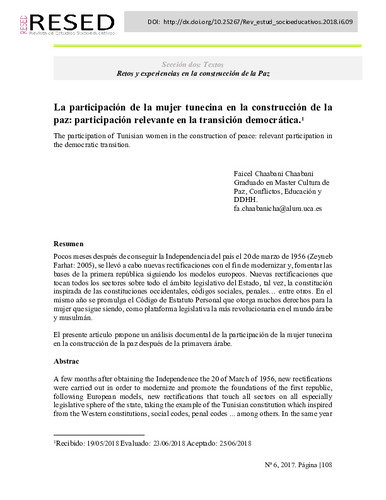
Pocos meses después de conseguir la Independencia del país el 20 de marzo de 1956 (Zeyneb Farhat: 2005), se llevó a cabo nuevas rectificaciones con el fin de modernizar y, fomentar las bases de la primera república siguiendo los modelos europeos. Nuevas rectificaciones que tocan todos los sectores sobre todo el ámbito legislativo del Estado, tal vez, la constitución inspirada de las constituciones occidentales, códigos sociales, penales… entre otros. En el mismo año se promulga el Código de Estatuto Personal que otorga muchos derechos para la mujer que sigue siendo, como plataforma legislativa la más revolucionaria en el mundo árabe y musulmán.
El presente artículo propone un análisis documental de la participación de la mujer tunecina en la construcción de la paz después de la primavera árabe A few months after obtaining the Independence the 20 of March of 1956, new rectifications were carried out in order to modernize and promote the foundations of the first republic, following European models, new rectifications that touch all sectors on all especially legislative sphere of the state, taking the example of the Tunisian constitution which inspired from the Western constitutions, social codes, penal codes ... among others. In the same year the Code of Personal Status was promulgated giving many rights to the women who remain, till now as the legislative platform the most revolutionary in the Arab and Muslim world.
This article proposes a documentary analysis of the participation of the Tunisian women in the construction of peace after the Arab Spring.
Colecciones
- RESED nº06 (2018) [19]

Esta obra está bajo una Licencia Creative Commons Attribution-NonCommercial-NoDerivatives 4.0 Internacional