Is Mental Well-Being in the Oldest Old Different from That in Younger Age Groups? Exploring the Mental Well-Being of the Oldest-Old Population in Europe
Identificadores
URI: http://hdl.handle.net/10498/23507
DOI: 10.1007/s10902-020-00292-y
ISSN: 1389-4978
ISSN: 1573-7780 (internet)
Ficheros
Estadísticas
Métricas y Citas
Exportar a





Metadatos
Mostrar el registro completo del ítem
Fecha
2020-07Fuente
Journal of Happiness StudiesResumen
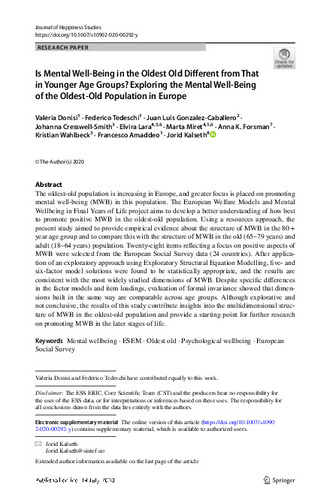
The oldest-old population is increasing in Europe, and greater focus is placed on promoting mental well-being (MWB) in this population. The European Welfare Models and Mental Wellbeing in Final Years of Life project aims to develop a better understanding of how best to promote positive MWB in the oldest-old population. Using a resources approach, the present study aimed to provide empirical evidence about the structure of MWB in the 80 + year age group and to compare this with the structure of MWB in the old (65-79 years) and adult (18-64 years) population. Twenty-eight items reflecting a focus on positive aspects of MWB were selected from the European Social Survey data (24 countries). After application of an exploratory approach using Exploratory Structural Equation Modelling, five- and six-factor model solutions were found to be statistically appropriate, and the results are consistent with the most widely studied dimensions of MWB. Despite specific differences in the factor models and item loadings, evaluation of formal invariance showed that dimensions built in the same way are comparable across age groups. Although explorative and not conclusive, the results of this study contribute insights into the multidimensional structure of MWB in the oldest-old population and provide a starting point for further research on promoting MWB in the later stages of life.
Colecciones
- Artículos Científicos [12023]
- Articulos Científicos Est. I.O. [361]
- Artículos Científicos INIBICA [1094]

Esta obra está bajo una Licencia Creative Commons Atribución 4.0 Internacional