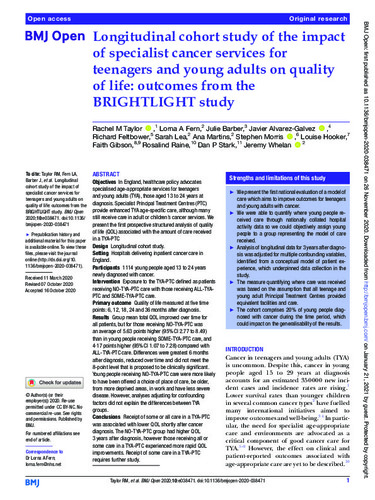
Longitudinal cohort study of the impact of specialist cancer services for teenagers and young adults on quality of life: outcomes from the BRIGHTLIGHT study
Identificadores
URI: http://hdl.handle.net/10498/24284
DOI: 10.1136/bmjopen-2020-038471
ISSN: 2044-6055
Files
Statistics
Metrics and citations
Export





Metadata
Show full item record
Date
2020Source
BMJ Open 2020;10:e038471Abstract
Objectives
In England, healthcare policy advocates specialised age-appropriate services for teenagers and young adults (TYA), those aged 13 to 24 years at diagnosis. Specialist Principal Treatment Centres (PTC) provide enhanced TYA age-specific care, although many still receive care in adult or children's cancer services. We present the first prospective structured analysis of quality of life (QOL) associated with the amount of care received in a TYA-PTC
Design
Longitudinal cohort study.
Setting
Hospitals delivering inpatient cancer care in England.
Participants
1114 young people aged 13 to 24 years newly diagnosed with cancer.
Intervention
Exposure to the TYA-PTC defined as patients receiving NO-TYA-PTC care with those receiving ALL-TYA-PTC and SOME-TYA-PTC care.
Primary outcome
Quality of life measured at five time points: 6, 12, 18, 24 and 36 months after diagnosis.
Results
Group mean total QOL improved over time for all patients, but for those receiving NO-TYA-PTC was an average of 5.63 points higher (95% CI 2.77 to 8.49) than in young people receiving SOME-TYA-PTC care, and 4 center dot 17 points higher (95% CI 1.07 to 7.28) compared with ALL-TYA-PTC care. Differences were greatest 6 months after diagnosis, reduced over time and did not meet the 8-point level that is proposed to be clinically significant. Young people receiving NO-TYA-PTC care were more likely to have been offered a choice of place of care, be older, from more deprived areas, in work and have less severe disease. However, analyses adjusting for confounding factors did not explain the differences between TYA groups.
Conclusions
Receipt of some or all care in a TYA-PTC was associated with lower QOL shortly after cancer diagnosis. The NO-TYA-PTC group had higher QOL 3 years after diagnosis, however those receiving all or some care in a TYA-PTC experienced more rapid QOL improvements. Receipt of some care in a TYA-PTC requires further study.
Collections
- Artículos Científicos [11595]
- Articulos Científicos Biomedicina [565]

This work is under a Creative Commons License Atribución 4.0 Internacional