Faecal microbiota and antibiotic resistance genes in migratory waterbirds with contrasting habitat use.
Identificadores
URI: http://hdl.handle.net/10498/24955
DOI: 10.1016/j.scitotenv.2021.146872
ISSN: 1879-1026
Ficheros
Estadísticas
Métricas y Citas
Exportar a





Metadatos
Mostrar el registro completo del ítem
Fecha
2021-04Fuente
Science of the Total Environment 783 (2021) 146872Resumen
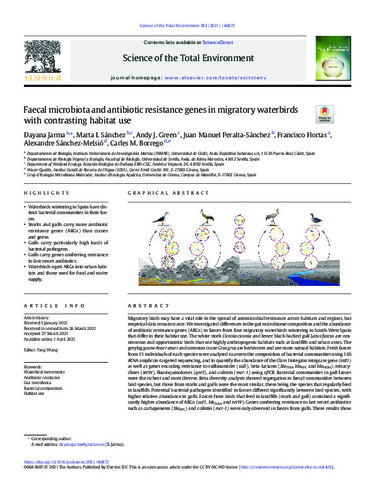
Migratory birds may have a vital role in the spread of antimicrobial resistance across habitats and regions, but empirical data remain scarce. We investigated differences in the gut microbiome composition and the abundance of antibiotic resistance genes (ARGs) in faeces from four migratory waterbirds wintering in South-West Spain that differ in their habitat use. The white stork Ciconia ciconia and lesser black-backed gull Larus fuscus are omnivorous and opportunistic birds that use highly anthropogenic habitats such as landfills and urban areas. The greylag goose Anser anser and common crane Grus grus are herbivores and use more natural habitats. Fresh faeces from 15 individuals of each species were analysed to assess the composition of bacterial communities using 16S rRNA amplicon-targeted sequencing, and to quantify the abundance of the Class I integron integrase gene (intI1) as well as genes encoding resistance to sulfonamides (sul1), beta-lactams (blaTEM, blaKPC and blaNDM), tetracyclines (tetW), fluoroquinolones (qnrS), and colistin (mcr-1) using qPCR. Bacterial communities in gull faeces were the richest and most diverse. Beta diversity analysis showed segregation in faecal communities between bird species, but those from storks and gulls were the most similar, these being the species that regularly feed in landfills. Potential bacterial pathogens identified in faeces differed significantly between bird species, with higher relative abundance in gulls. Faeces from birds that feed in landfills (stork and gull) contained a significantly higher abundance of ARGs (sul1, blaTEM, and tetW). Genes conferring resistance to last resort antibiotics such as carbapenems (blaKPC) and colistin (mcr-1) were only observed in faeces from gulls. These results show that these bird species are reservoirs of antimicrobial resistant bacteria and suggest that waterbirds may disseminate antibiotic resistance across environments (e.g., from landfills to ricefields or water supplies), and thus constitute a risk for their further spread to wildlife and humans.
Copyright © 2021 Elsevier B.V. All rights reserved.
Colecciones
- Artículos Científicos [12009]
- Articulos Científicos Biología [865]
- Artículos Científicos INMAR [1043]

Esta obra está bajo una Licencia Creative Commons Attribution-NonCommercial-NoDerivatives 4.0 Internacional