Multi-omic approach to evaluate the response of gilt-head sea bream (Sparus aurata) exposed to the UV filter sulisobenzone
Identificadores
URI: http://hdl.handle.net/10498/25349
DOI: 10.1016/j.scitotenv.2021.150080
ISSN: 0048-9697
Statistics
Metrics and citations
Export





Metadata
Show full item record
Date
2022-01Source
Science of the Total Environment 803 (2022) 150080Abstract
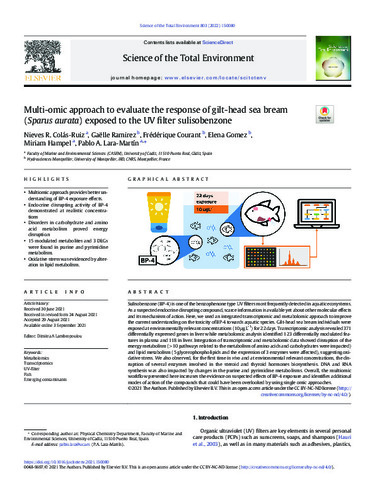
Sulisobenzone (BP-4) is one of the benzophenone type UVfiltersmost frequently detected in aquatic ecosystems.
As a suspected endocrine disrupting compound, scarce information is available yet about other molecular effects
and its mechanismof action. Here, we used an integrated transcriptomic and metabolomic approach to improve
the current understanding on the toxicity of BP-4 towards aquatic species. Gilt-head sea bream individualswere
exposed at environmentally relevant concentrations (10 μg L-1) for 22 days. Transcriptomic analysis revealed 371
differentially expressed genes in liver while metabolomic analysis identified 123 differentially modulated features
in plasma and 118 in liver. Integration of transcriptomic and metabolomic data showed disruption of the
energy metabolism(>10 pathways related to the metabolismof amino acids and carbohydrateswere impacted)
and lipid metabolism (5 glycerophospholipids and the expression of 3 enzymes were affected), suggesting oxidative
stress.We also observed, for the first time in vivo and at environmental relevant concentrations, the disruption
of several enzymes involved in the steroid and thyroid hormones biosynthesis. DNA and RNA
synthesis was also impacted by changes in the purine and pyrimidine metabolisms. Overall, the multiomic
workflow presented here increases the evidence on suspected effects of BP-4 exposure and identifies additional
modes of action of the compounds that could have been overlooked by using single omic approaches.
©2021 The Authors. Published by Elsevier B.V.
Collections
- Artículos Científicos [11777]
- Artículos Científicos INMAR [1027]
- Articulos Científicos Quim. Fis. [258]

This work is under a Creative Commons License Attribution-NonCommercial-NoDerivatives 4.0 Internacional