Analysis and comparison of monofocal, extended depth of focus and trifocal intraocular lens profiles
Identificadores
URI: http://hdl.handle.net/10498/27158
DOI: 10.1038/s41598-022-12694-4
ISSN: 2045-2322
Files
Statistics
Metrics and citations
Export





Metadata
Show full item record
Date
2022-05Source
Sci Rep 12, 8654 (2022)Abstract
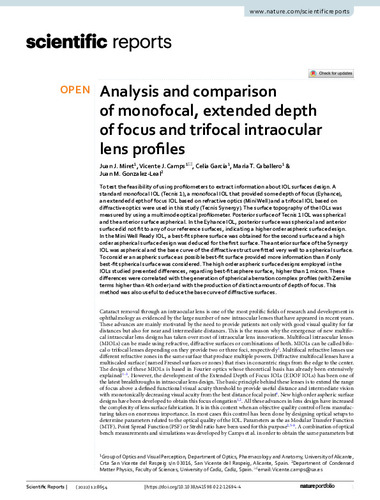
To test the feasibility of using profilometers to extract information about IOL surfaces design. A standard monofocal IOL (Tecnis 1), a monofocal IOL that provided some depth of focus (Eyhance), an extended depth of focus IOL based on refractive optics (Mini Well) and a trifocal IOL based on diffractive optics were used in this study (Tecnis Synergy). The surface topography of the IOLs was measured by using a multimode optical profilometer. Posterior surface of Tecnis 1 IOL was spherical and the anterior surface aspherical. In the Eyhance IOL, posterior surface was spherical and anterior surface did not fit to any of our reference surfaces, indicating a higher order aspheric surface design. In the Mini Well Ready IOL, a best-fit sphere surface was obtained for the second surface and a high order aspherical surface design was deduced for the first surface. The anterior surface of the Synergy IOL was aspherical and the base curve of the diffractive structure fitted very well to a spherical surface. To consider an aspheric surface as possible best-fit surface provided more information than if only best-fit spherical surface was considered. The high order aspheric surface designs employed in the IOLs studied presented differences, regarding best-fit asphere surface, higher than 1 micron. These differences were correlated with the generation of spherical aberration complex profiles (with Zernike terms higher than 4th order) and with the production of distinct amounts of depth of focus. This method was also useful to deduce the base curve of diffractive surfaces.
Collections
- Artículos Científicos [11595]
- Articulos Científicos Fis. Mat. Cond. [127]
- Artículos Científicos IMEYMAT [563]

This work is under a Creative Commons License Atribución 4.0 Internacional