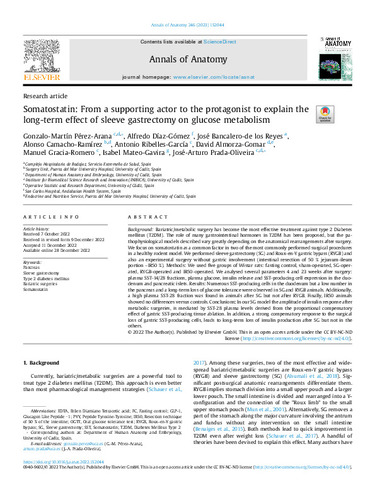
Somatostatin: From a supporting actor to the protagonist to explain the long-term effect of sleeve gastrectomy on glucose metabolism.
Identificadores
URI: http://hdl.handle.net/10498/27881
DOI: 10.1016/j.aanat.2022.152044
ISSN: 1618-0402
Ficheros
Estadísticas
Métricas y Citas
Exportar a





Metadatos
Mostrar el registro completo del ítem
Fecha
2022-12Fuente
Annals of Anatomy, Vol. 246Resumen
BACKGROUND: Bariatric/metabolic surgery has become the most effective treatment against type 2 Diabetes mellitus (T2DM). The role of many gastrointestinal hormones in T2DM has been proposed, but the pathophysiological models described vary greatly depending on the anatomical rearrangements after surgery. We focus on somatostatin as a common factor in two of the most commonly performed surgical procedures in a healthy rodent model. We performed sleeve gastrectomy (SG) and Roux-en-Y gastric bypass (RYGB) and also an experimental surgery without gastric involvement (intestinal resection of 50 % jejunum-ileum portion -IR50 %).
METHODS: We used five groups of Wistar rats: fasting control, sham-operated, SG-operated, RYGB-operated and IR50-operated. We analysed several parameters 4 and 23 weeks after surgery: plasma SST-14/28 fractions, plasma glucose, insulin release and SST-producing cell expression in the duodenum and pancreatic islets.
RESULTS: Numerous SST-producing cells in the duodenum but a low number in the pancreas and a long-term loss of glucose tolerance were observed in SG and RYGB animals. Additionally, a high plasma SST-28 fraction was found in animals after SG but not after RYGB. Finally, IR50 animals showed no differences versus controls.
CONCLUSIONS: In our SG model the amplitude of insulin response after metabolic surgeries, is mediated by SST-28 plasma levels derived from the proportional compensatory effect of gastric SST-producing tissue ablation. In addition, a strong compensatory response to the surgical loss of gastric SST-producing cells, leads to long-term loss of insulin production after SG but not in the others.
Copyright © 2022 The Author(s). Published by Elsevier GmbH.. All rights reserved.
Colecciones
- Artículos Científicos [12089]
- Articulos Científicos Anat. Emb. [93]
- Articulos Científicos Est. I.O. [366]
- Artículos Científicos INIBICA [1098]

Esta obra está bajo una Licencia Creative Commons Attribution-NonCommercial-NoDerivatives 4.0 Internacional