Activity and efficiency trends for the residential sector across countries
Identificadores
URI: http://hdl.handle.net/10498/28408
DOI: 10.1016/j.enbuild.2022.112428
ISSN: 0378-7788
Ficheros
Estadísticas
Métricas y Citas
Exportar a





Metadatos
Mostrar el registro completo del ítem
Fecha
2022-10Fuente
Energy and Buildings, Vol. 273, 2022Resumen
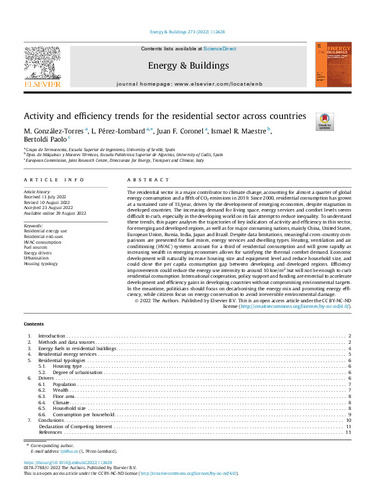
The residential sector is a major contributor to climate change, accounting for almost a quarter of global energy consumption and a fifth of CO2 emissions in 2019. Since 2000, residential consumption has grown at a sustained rate of 1%/year, driven by the development of emerging economies, despite stagnation in developed countries. The increasing demand for living space, energy services and comfort levels seems difficult to curb, especially in the developing world on its fair attempt to reduce inequality. To understand these trends, this paper analyses the trajectories of key indicators of activity and efficiency in this sector, for emerging and developed regions, as well as for major consuming nations, mainly China, United States, European Union, Russia, India, Japan and Brazil. Despite data limitations, meaningful cross-country comparisons are presented for fuel mixes, energy services and dwelling types. Heating, ventilation and air conditioning (HVAC) systems account for a third of residential consumption and will grow rapidly as increasing wealth in emerging economies allows for satisfying the thermal comfort demand. Economic development will naturally increase housing size and equipment level and reduce household size, and could close the per capita consumption gap between developing and developed regions. Efficiency improvements could reduce the energy use intensity to around 10 koe/m(2) but will not be enough to curb residential consumption. International cooperation, policy support and funding are essential to accelerate development and efficiency gains in developing countries without compromising environmental targets. In the meantime, politicians should focus on decarbonising the energy mix and promoting energy efficiency, while citizens focus on energy conservation to avoid irreversible environmental damage. (c) 2022 The Authors. Published by Elsevier B.V. This is an open access article under the CC BY-NC-ND license (http://creativecommons.org/licenses/by-nc-nd/4.0/).
Colecciones
- Artículos Científicos [11777]
- Articulos Científicos Maq. Mot. Térm. [108]

Esta obra está bajo una Licencia Creative Commons Attribution-NonCommercial-NoDerivatives 4.0 Internacional