El teatro español del horror de entre-siglos: diez ejemplos de escenografía gótica en los siglos XVIII y XIX
Identificadores
URI: http://hdl.handle.net/10498/29493
DOI: 10.25267/Cuad_Ilus_romant.2023.i29.15
ISSN: 2173-0687
Statistics
Metrics and citations
Export





Metadata
Show full item recordAlternative title
The spanish horror theatre at the turn of the century: ten examples of gothic scenography between the 18th and 19th centuries
Date
2023-10-15Source
Cuadernos de Ilustración y Romanticismo - 2023. Nº 29, pp. 259-281Abstract
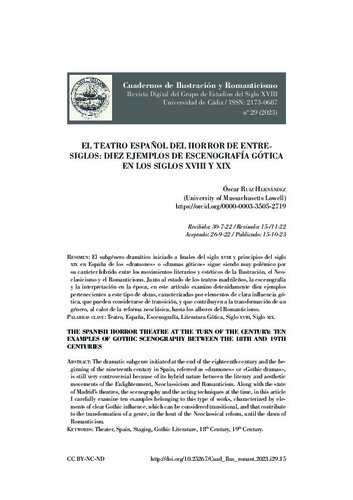
El subgénero dramático iniciado a finales del siglo XVIII y principios del siglo XIX en España de los «dramones» o «dramas góticos» sigue siendo muy polémico por su carácter híbrido entre los movimientos literarios y estéticos de la Ilustración, el Neoclasicismo y el Romanticismo. Junto al estado de los teatros madrileños, la escenografía y la interpretación en la época, en este artículo examino detenidamente diez ejemplos pertenecientes a este tipo de obras, caracterizadas por elementos de clara influencia gótica, que pueden considerarse de transición, y que contribuyen a la transformación de un género, al calor de la reforma neoclásica, hasta los albores del Romanticismo. The dramatic subgenre initiated at the end of the eighteenth century and the be-ginning of the nineteenth century in Spain, referred as «dramones» or «Gothic dramas», is still very controversial because of its hybrid nature between the literary and aesthetic movements of the Enlightenment, Neoclassicism and Romanticism. Along with the state of Madrid’s theatres, the scenography and the acting techniques at the time, in this article I carefully examine ten examples belonging to this type of works, characterized by ele-ments of clear Gothic influence, which can be considered transitional, and that contribute to the transformation of a genre, in the heat of the Neoclassical reform, until the dawn of Romanticism.
Collections

This work is under a Creative Commons License Attribution-NonCommercial-NoDerivatives 4.0 Internacional