Eco-toxicity assessment of industrial by-product-based alkali-activated binders using the sea urchin embryogenesis bioassay
Identificadores
URI: http://hdl.handle.net/10498/29536
DOI: 10.1016/j.jenvman.2023.118100
ISSN: 0301-4797
Ficheros
Estadísticas
Métricas y Citas
Exportar a





Metadatos
Mostrar el registro completo del ítem
Fecha
2023-05-18Fuente
Journal of Environmental Management. Vol. 341, 1 September 2023, 118100Resumen
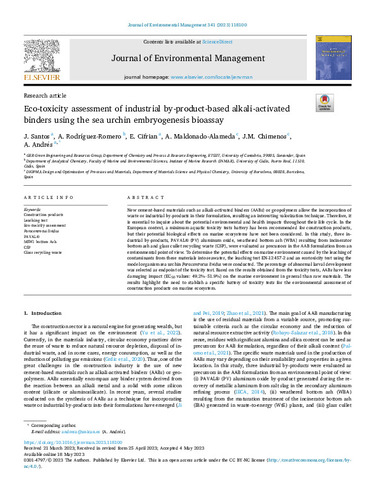
New cement-based materials such as alkali-activated binders (AABs) or geopolymers allow the incorporation of waste or industrial by-products in their formulation, resulting an interesting valorization technique. Therefore, it is essential to inquire about the potential environmental and health impacts throughout their life cycle. In the European context, a minimum aquatic toxicity tests battery has been recommended for construction products, but their potential biological effects on marine ecosystems have not been considered. In this study, three industrial by-products, PAVAL® (PV) aluminum oxide, weathered bottom ash (WBA) resulting from incinerator bottom ash and glass cullet recycling waste (CSP), were evaluated as precursors in the AAB formulation from an environmental point of view. To determine the potential effects on marine environment caused by the leaching of contaminants from these materials into seawater, the leaching test EN-12457-2 and an ecotoxicity test using the model organism sea urchin Paracentrotus lividus were conducted. The percentage of abnormal larval development was selected as endpoint of the toxicity test. Based on the results obtained from the toxicity tests, AABs have less damaging impact (EC50 values: 49.2%–51.9%) on the marine environment in general than raw materials. The results highlight the need to stablish a specific battery of toxicity tests for the environmental assessment of construction products on marine ecosystem
Colecciones
- Artículos Científicos [11777]
- Artículos Científicos INMAR [1027]
- Articulos Científicos Quim. Ana. [393]

Esta obra está bajo una Licencia Creative Commons Atribución-NoComercial 4.0 Internacional